微积分 - 极限和连续 - 部分习题及答案
平均变化率 - 习题
在题 1 - 4中,求给定区间上函数的平均变化率
-
$ f(x) = x^3 + 1 $
-
[2, 3] $$ \frac{\Delta y}{\Delta x} = \frac{f(x_2) - f(x_1)}{x_2 - x_1} = \frac{(3^3 + 1) - (2^3 + 1)}{3 - 2} = 3 $$
-
[-1, 1] $$ \frac{\Delta y}{\Delta x} = \frac{f(x_2) - f(x_1)}{x_2 - x_1} = \frac{(1^3 + 1) - ((-1)^3 + 1)}{1 - (-1)} = 1 $$
-
-
$ R(\theta) = \sqrt{4 \theta + 1} $
- [0, 2] $$ \frac{\Delta y}{\Delta x} = \frac{f(x_2) - f(x_1)}{x_2 - x_1} = \frac{(\sqrt{4 \cdot 2 + 1}) - (\sqrt{4 \cdot 0 + 1})}{2 - 0} = 1 $$
-
$ h(t) = \cot t $
-
$ [ \frac{\pi}{4}, \frac{3 \pi}{4} ] $ $$ \frac{\Delta y}{\Delta x} = \frac{f(x_2) - f(x_1)}{x_2 - x_1} = \frac{(\cot \frac{3 \pi}{4}) - (\cot \frac{\pi}{4})}{\frac{3 \pi}{4} - \frac{\pi}{4}} = \frac{-2}{\frac{\pi}{2}} = -\frac{4}{\pi} $$
-
$ [\frac{\pi}{6}, \frac{\pi}{2}] $ $$ \frac{\Delta y}{\Delta x} = \frac{f(x_2) - f(x_1)}{x_2 - x_1} = \frac{(\cot \frac{\pi}{2}) - (\cot \frac{\pi}{6})}{\frac{\pi}{2} - \frac{\pi}{6}} = \frac{0 - \sqrt{3}}{\frac{2\pi}{6}} = \frac{-\sqrt{3}}{\frac{\pi}{3}} = -\sqrt{3} \cdot \frac{3}{\pi} = -\frac{3\sqrt{3}}{\pi} $$
-
-
$ g(t) = 2 + \cos t $
-
$ [0, \pi] $ $$ \frac{\Delta y}{\Delta x} = \frac{f(x_2) - f(x_1)}{x_2 - x_1} = \frac{(2 + \cos \pi) - (2 + \cos 0)}{\pi - 0} = \frac{-1 + 3}{\pi} = -\frac{2}{\pi} $$
-
$ [-\pi, \pi] $ $$ \frac{\Delta y}{\Delta x} = \frac{f(x_2) - f(x_1)}{x_2 - x_1} = \frac{(2 + \cos \pi) - (2 - \cos \pi)}{\pi - (-\pi)} = \frac{1 - 1}{2\pi} = \frac{0}{2\pi} = 0 $$
-
福特马特眼镜蛇的汽车的速度
-
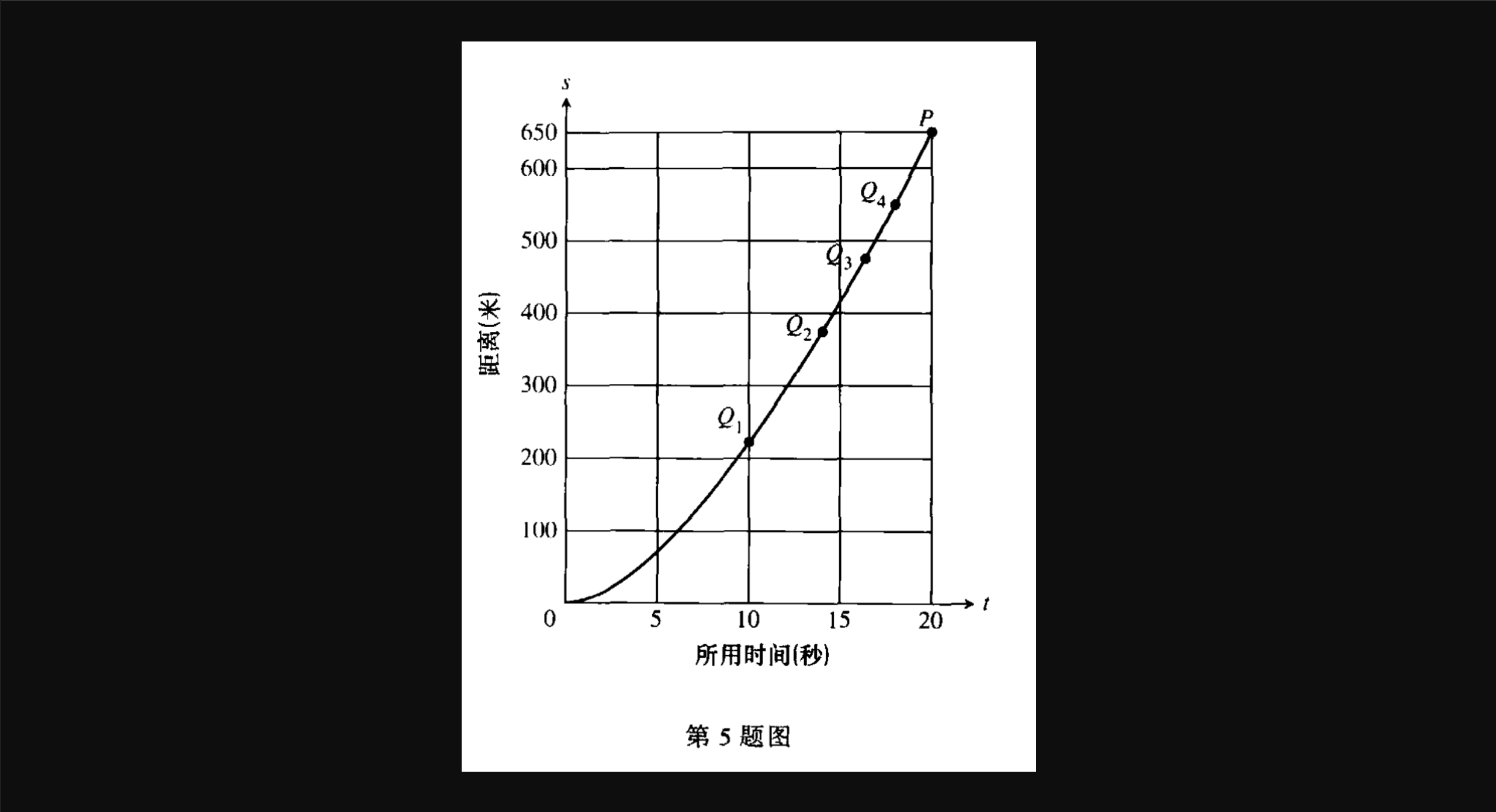
下图展示了1994 福特汽车从静止开始加速后的时间对距离的图形

-
估算割线 $ PQ_1, PQ_2, PQ_3 $ 和 $ PQ_4 $ 的斜率 $$ \text{割线的斜率其实就是平均变化率,我在这只计算一个} PQ_1 \\ \\ \frac{\Delta y}{\Delta x} = \frac{f(x_2) - f(x_1)}{x_2 - x_1} = \frac{650 - 220}{20 - 10} = \frac{430}{10} = 43 $$
-
估算该型号汽车在 $ t = 20 $秒的速度
我们可以通过观察割线斜率的趋势来估算这个值。当点 Q 越来越接近点 P 时,割线 PQ 的斜率会越来越接近点 P 处切线的斜率。
从图像上可以观察到,大约从 t=12 秒之后,图像变成了一条直线。这意味着汽车进入了匀速行驶阶段。对于一条直线,其上任意点的切线斜率都等于直线本身的斜率。
因此,我们可以确认,在 $ t = 20 $秒时,汽车的速度就是这段匀速阶段的速度。
结论:该型号汽车在 $ t = 20 $秒时的速度估算为 45 米/秒。
-
-
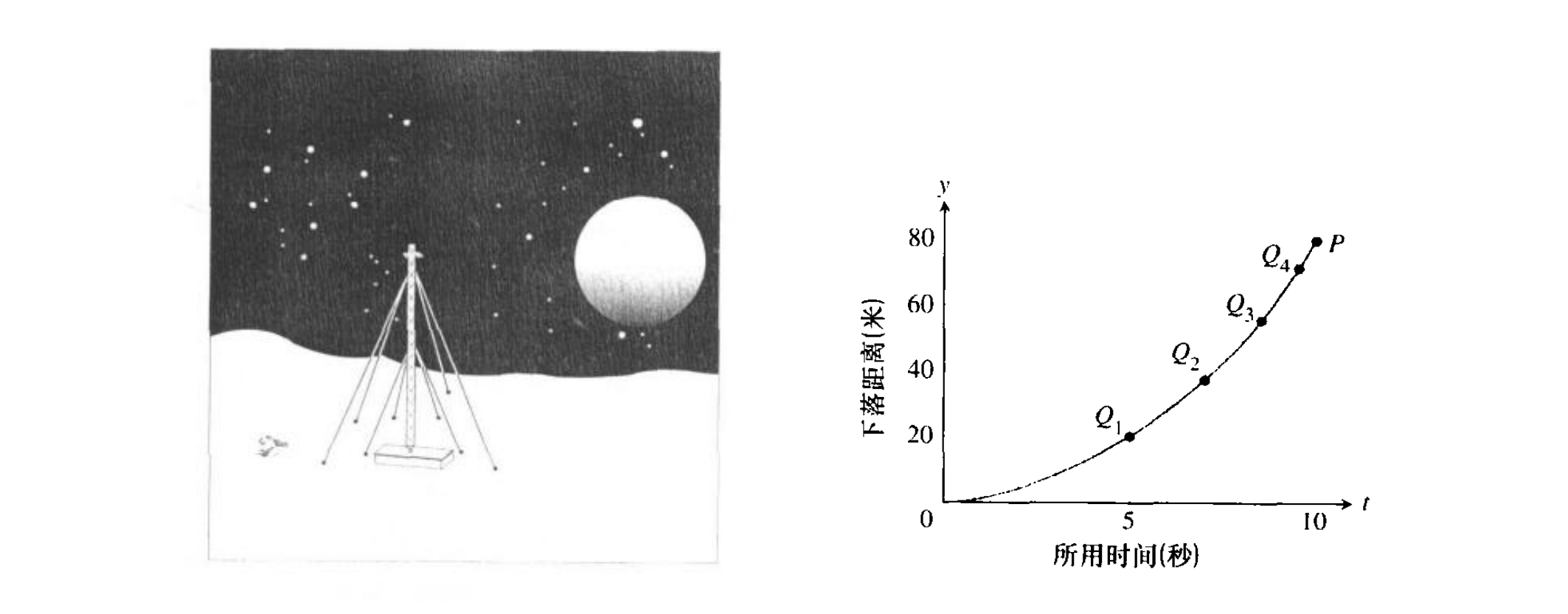
下落板钳的速度
-
估算割线 $ PQ_1, PQ_2, PQ_3 $ 和 $ PQ_4 $ 的斜率 $$ \text{割线的斜率其实就是平均变化率,我在这只计算一个} PQ_1 \\ \\ \frac{\Delta y}{\Delta x} = \frac{f(x_2) - f(x_1)}{x_2 - x_1} = \frac{80 - 20}{10 - 5} = \frac{60}{5} = 12 $$
-
当板钳在站顶时,他的下落速度有多快?
“在站顶时”指的是下落刚刚开始的时刻,即 t = 0 秒。
因此,当板钳在站顶时,他的下落速度是 0 米/秒。
-
-
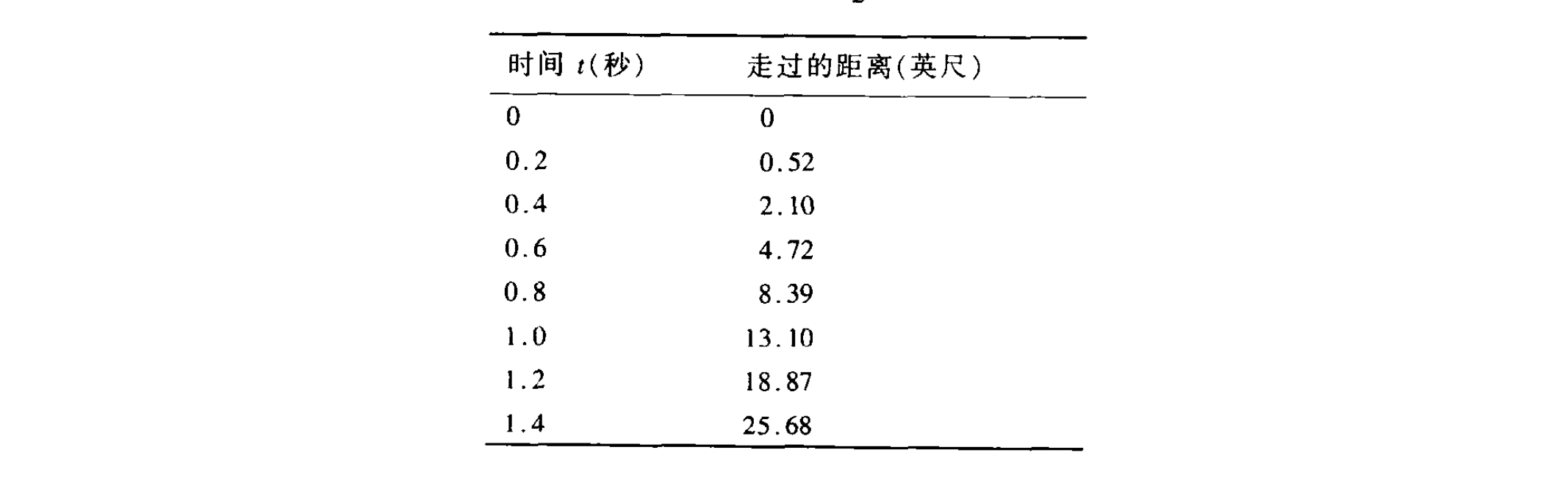
球的速度 附表的数据给出了从斜面上滚下的球的距离,试着通过找速度的上,下界并求其平均来估算 $ t = 1 $ 时的瞬时速度。即:求 $ a \leq v(1) \leq b $ 然后估算 $ v(1) $ 为 $ \frac{(a+b)}{2} $
$$
\begin{gather*}
\frac{\Delta y}{\Delta x}
= \frac{f(x_2) - f(x_1)}{x_2 - x_1}
= \frac{13.10 - 8.39}{1.0 - 0.8}
= \frac{4.71}{0.2}
= 23.55
\\ \\
\frac{\Delta y}{\Delta x}
= \frac{f(x_2) - f(x_1)}{x_2 - x_1}
= \frac{18.87 - 13.10}{1.2 - 1.0}
= \frac{5.77}{0.2}
= 28.85
\\ \\
v(1) = \frac{(a+b)}{2} = \frac{52.4}{2} = 26.2
\end{gather*}
$$ -
火车行进的距离
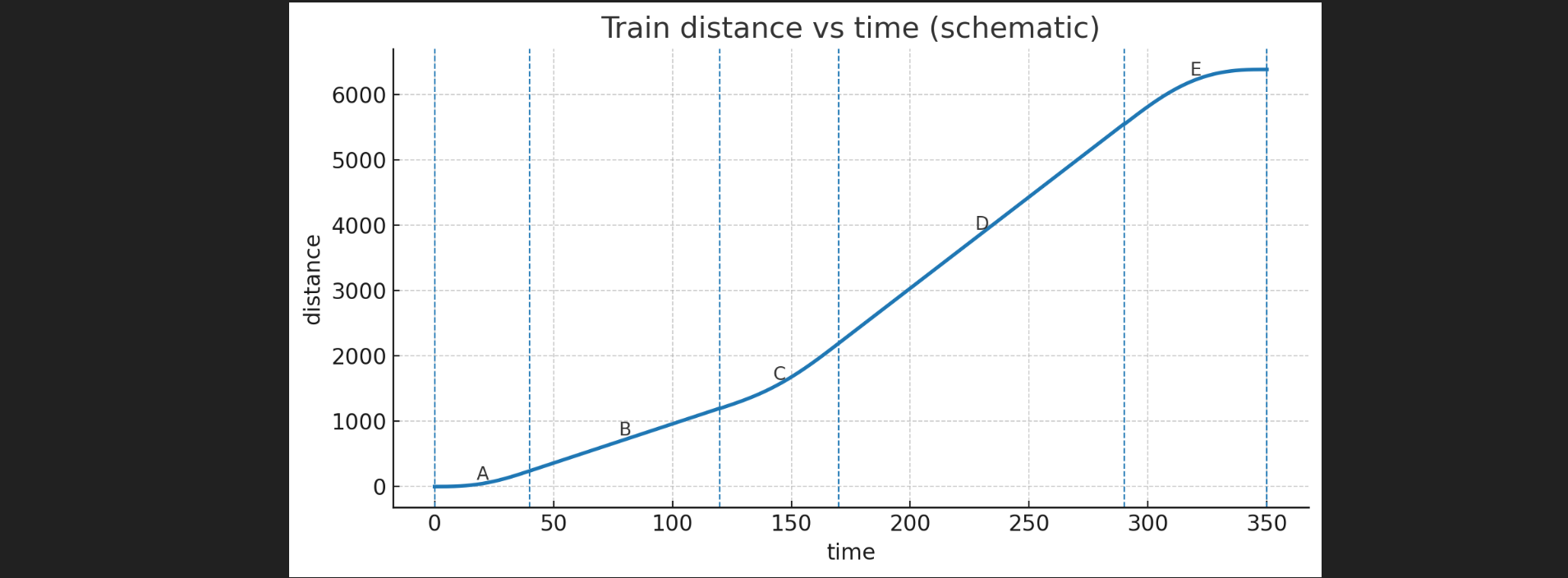
一辆火车从静止加速到的最大缓慢巡行速度,然后以某个常速度行经一个城镇,经过该城镇后又加速到他缓慢巡行速度。最后,火车平稳的减速直到到达目的地时停下来,试着画一个火车的行进距离作为时间的函数的可能的图形
- A:从静止加速到“缓慢巡行速度”(曲线向上、斜率逐渐变大)
- B:穿越城镇的匀速慢行(直线、斜率较小)
- C:驶出城镇后再次加速到更快的巡航(曲线向上、斜率继续变大)
- D:更高巡航速度的匀速段(直线、斜率更大)
- E:平稳减速至终点停下(曲线向上但逐渐变平,最后斜率为 0)
图中“斜率 = 速度”。加速段斜率随时间变大(凹向上),减速段斜率变小(凹向下),匀速段是直线。整条曲线单调递增、连续,在各阶段交界处可以有斜率的突变(理想化时也可光滑过渡)。
 $$
\begin{gather*}
\frac{\Delta y}{\Delta x}
= \frac{f(x_2) - f(x_1)}{x_2 - x_1}
= \frac{13.10 - 8.39}{1.0 - 0.8}
= \frac{4.71}{0.2}
= 23.55
\\ \\
\frac{\Delta y}{\Delta x}
= \frac{f(x_2) - f(x_1)}{x_2 - x_1}
= \frac{18.87 - 13.10}{1.2 - 1.0}
= \frac{5.77}{0.2}
= 28.85
\\ \\
v(1) = \frac{(a+b)}{2} = \frac{52.4}{2} = 26.2
\end{gather*}
$$
$$
\begin{gather*}
\frac{\Delta y}{\Delta x}
= \frac{f(x_2) - f(x_1)}{x_2 - x_1}
= \frac{13.10 - 8.39}{1.0 - 0.8}
= \frac{4.71}{0.2}
= 23.55
\\ \\
\frac{\Delta y}{\Delta x}
= \frac{f(x_2) - f(x_1)}{x_2 - x_1}
= \frac{18.87 - 13.10}{1.2 - 1.0}
= \frac{5.77}{0.2}
= 28.85
\\ \\
v(1) = \frac{(a+b)}{2} = \frac{52.4}{2} = 26.2
\end{gather*}
$$
对图形求极限 - 习题
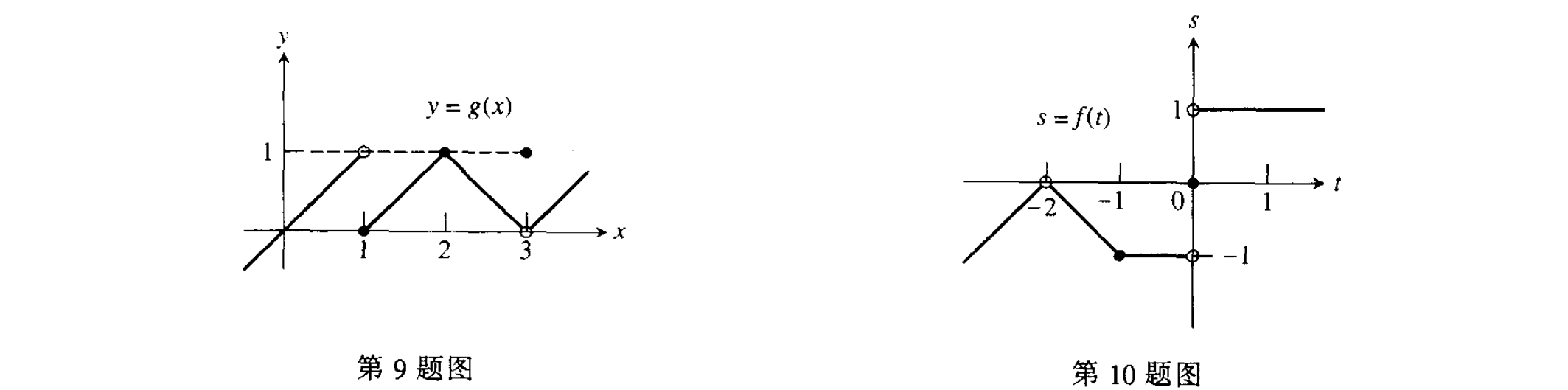
-
对左下图的函数 $g(x)$,求下列极限,或者解释说为什么没有极限
- $ \displaystyle \lim_{x \to 1} g(x) $
- 分析:
- 当 x 从左侧无限接近 1 时 $ (x→1^⁻) $,函数 $ g(x) $ 的值从图像上看趋近于 1。所以左极限是 1。
- 当 x 从右侧无限接近 1 时 $ (x→1^⁺) $,函数 $ g(x) $ 的值也趋近于 1。所以右极限是 1。
- 结论: 因为左极限和右极限相等,所以该点的极限存在。
- 答案: $ \displaystyle \lim_{x \to 1} g(x) = 1 $
- 分析:
- $ \displaystyle \lim_{x \to 2} g(x) $
- 分析:
- 当 x 从左侧无限接近 2 时 $ (x→2^⁻) $,函数 $ g(x) $ 的值趋近于 1。所以左极限是 1
- 当 x 从右侧无限接近 2 时 $ (x→2^⁺) $,函数 $ g(x) $ 的值也趋近于 1。所以右极限是 1。
- 结论: 因为左极限和右极限相等,所以该点的极限存在。
- 答案: $ \displaystyle \lim_{x \to 2} g(x) = 1 $
- 分析:
- $ \displaystyle \lim_{x \to 3} g(x) $
- 分析:
- 当 x 从左侧无限接近 3 时 $ (x→3^⁻) $,函数 $ g(x) $ 的值趋近于 0。所以左极限是 0。
- 当 x 从右侧无限接近 3 时 $ (x→3^⁺) $,函数 $ g(x) $ 的值也趋近于 0。所以右极限是 0。
- 结论: 因为左极限和右极限相等,所以该点的极限存在。
- 答案: $ \displaystyle \lim_{x \to 3} g(x) = 0 $
- 分析:
- 对于图片的函数 $ f(x) $,求下列极限,或结束为什么没有极限
- $ \displaystyle \lim_{t \to -2} f(t) $
- 分析:
- 当 t 从左侧无限接近 -2 时 $ (t→-2^⁻) $,函数 $ f(t) $ 的值趋近于 0。所以左极限是 0。
- 当 t 从右侧无限接近 -2 时 $ (t→-2^⁺) $,函数 $ f(t) $ 的值也趋近于 0。所以右极限是 0。
- 结论: 因为左极限和右极限相等,所以该点的极限存在。
- 答案: $ \displaystyle \lim_{t \to -2} f(t) = 0 $
- 分析:
- $ \displaystyle \lim_{t \to -1} f(t) $
- 分析:
- 当 t 从左侧无限接近 -1 时 $ (t→-1^⁻) $,函数 $ f(t) $ 的值趋近于 -1。所以左极限是 -1。
- 当 t 从右侧无限接近 -1 时 $ (t→-1^⁺) $,函数 $ f(t) $ 的值也趋近于 -1。所以右极限是 -1。
- 结论: 因为左极限和右极限相等,所以该点的极限存在。
- 答案: $ \displaystyle \lim_{t \to -1} f(t) = -1 $
- 分析:
- $ \displaystyle \lim_{t \to 0} f(t) $
- 分析:
- 当 t 从左侧无限接近 0 时 $ (t→0^⁻) $,函数 $ f(t) $ 的值趋近于 -1。所以左极限是 -1。
- 当 t 从右侧无限接近 0 时 $ (t→0^⁺) $,函数 $ f(t) $ 的值趋近于 1。所以右极限是 1。
- 结论: 因为左极限 (-1) 不等于右极限 (1),所以该点的极限不存在。
- 答案: 极限不存在
- 分析:
- $ \displaystyle \lim_{t \to -2} f(t) $
- $ \displaystyle \lim_{x \to 1} g(x) $
从图形估计极限 - 习题
在题 1 - 6 中,利用图形来估算函数的极限,或解释为什么极限不存在
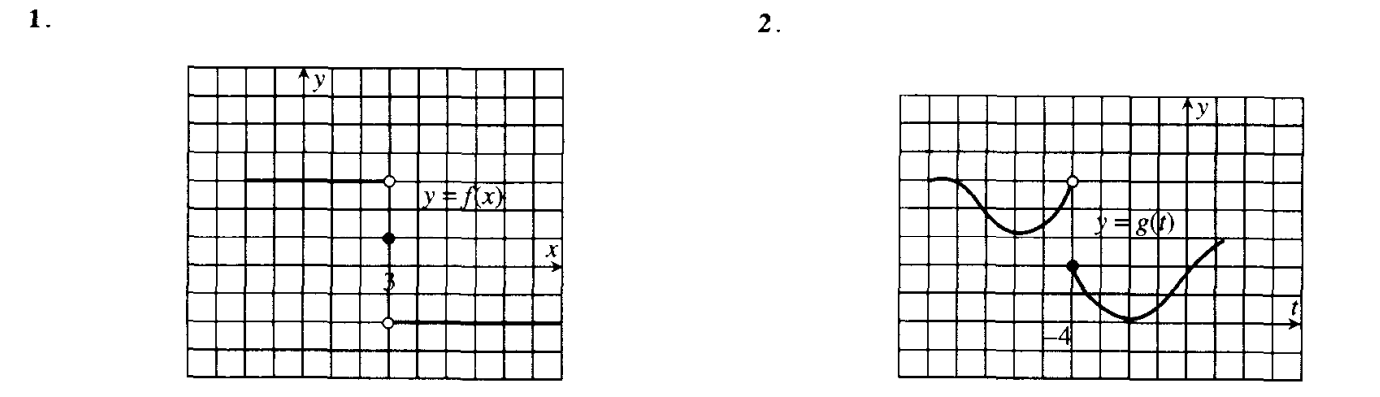
-
- $ \displaystyle \lim_{x \to 3^-} f(x) $
- 分析:
- 当 x 从左侧无限接近 3 时 $ (x \to 3^⁻) $,函数 $ f(x) $ 的值趋近于 3。所以左极限是 3。
- 答案: $ \displaystyle \lim_{x \to 3^-} f(x) = 3 $
- 分析:
- $ \displaystyle \lim_{x \to 3^+} f(x) $
- 分析:
- 当 x 从右侧无限接近 3 时 $ (x \to 3^+) $,函数 $ f(x) $ 的值趋近于 -2。所以右极限是 -2。
- 答案: $ \displaystyle \lim_{x \to 3^+} f(x) = -2 $
- 分析:
- $ \displaystyle \lim_{x \to 3} f(x) $
- 分析:
- 当 x 从左侧无限接近 3 时 $ (x \to 3^⁻) $,函数 $ f(x) $ 的值趋近于 3。所以左极限是 3。
- 当 x 从右侧无限接近 3 时 $ (x \to 3^+) $,函数 $ f(x) $ 的值趋近于 -2。所以右极限是 -2。
- 答案: 因为左极限跟右极限不一样,所以极限不存在
- 分析:
- $ f(3) $
- 分析:
- 我们观察图像,在 x=3 的位置,有一个实心点,这个点对应的 y 值是 1(注意:极限值与函数在该点是否有定义或取值是多少没有必然联系)
- 答案: $ f(3) = 1 $
- 分析:
- $ \displaystyle \lim_{x \to 3^-} f(x) $
-
- $ \displaystyle \lim_{ t \to (-4)^-} g(t) $
- 分析:
- 当 t 从左侧无限接近 -4 时 $ (t \to -4^⁻) $,函数 $ g(t) $ 的值趋近于 5。所以左极限是 5。
- 答案: $ \displaystyle \lim_{ t \to (-4)^-} g(t) = 5 $
- 分析:
- $ \displaystyle \lim_{t \to (-4)^+} g(t) $
- 分析:
- 当 t 从右侧无限接近 -4 时 $ (t \to -4^+) $,函数 $ g(t) $ 的值趋近于 5。所以右极限是 5。
- 答案: $ \displaystyle \lim_{ t \to (-4)^+} g(t) = 5 $
- 分析:
- $ \displaystyle \lim_{t \to -4} g(t) $
- 分析:
- 当 t 从左侧无限接近 -4 时 $ (t \to -4^⁻) $,函数 $ g(t) $ 的值趋近于 5。所以左极限是 5。
- 当 t 从右侧无限接近 -4 时 $ (t \to -4^+) $,函数 $ g(t) $ 的值趋近于 5。所以右极限是 5。
- 答案: $ \displaystyle \lim_{t \to -4} g(t) = 5 $
- 分析:
- $ g(-4) $
- 分析:
- 我们观察图像,在 t=-4 的位置,有一个实心点,这个点对应的 y 值是 2(注意:极限值与函数在该点是否有定义或取值是多少没有必然联系)
- 答案: $ g(-4) = 2 $
- 分析:
- $ \displaystyle \lim_{ t \to (-4)^-} g(t) $
运用极限法则 - 习题
-
假设 $ \displaystyle \lim_{x \to 0} f(x) = 1$ 和 $ \displaystyle \lim_{x \to 0} g(x) = 5$,写出下面计算中步骤(a)(b)(c)中用得到的定理1中法则的名称 $$ \displaystyle \lim_{x \to 0} f(x) = 1 和 \displaystyle \lim_{x \to 0} g(x) = 5 $$ (a)商法则
(b)幂法则
(c)积法则
-
设 $ \displaystyle \lim_{x \to 1}h(x) = 5, \lim_{x \to 1}p(x) = 1,\lim_{x \to 1}r(x) = -2 $ 写出下面计算中步骤(a)(b)(c)中用到的定理1中法则的名称 $$ \displaystyle \lim_{x \to 1}h(x) = 5, \lim_{x \to 1}p(x) = 1,\lim_{x \to 1}r(x) = -2 $$ (a)商法则
(b)幂法则
(c)积法则
-
假设 $ \displaystyle \lim_{x \to c} f(x) = 5 $ 以及 $ \displaystyle \lim_{x \to c} g(x) = -2 $求:
-
$ \displaystyle \lim_{x \to c} f(x) g(x) $ $$ \begin{gather*} \displaystyle \lim_{x \to c} f(x) g(x) = 5 (-2) = -10 \end{gather*} $$
-
$ \displaystyle \lim_{x \to c} 2 f(x) g(x) $ $$ \begin{gather*} \displaystyle \lim_{x \to c} 2 f(x) g(x) = (2 \cdot 5) (-2) = 10 \cdot (-2) = -20 \end{gather*} $$
-
$ \displaystyle \lim_{x \to c} (f(x) + 3g(x)) $ $$ \begin{gather*} \displaystyle \lim_{x \to c} (f(x) + 3g(x)) = (5 + 3(-2)) = 5 - 6 = -1 \end{gather*} $$
-
$ \displaystyle \lim_{x \to c} \frac{f(x)}{f(x) - g(x)} $ $$ \displaystyle \lim_{x \to c} \frac{f(x)}{f(x) - g(x)} = \frac{5}{5 - (-2)} = \frac{5}{7} $$
-
-
假设 $ \displaystyle \lim_{x \to c} f(x) = 0 $ 以及 $ \displaystyle \lim_{x \to c} g(x) = -3 $求:
- $ \displaystyle \lim_{x \to 4} (g(x) + 3) $
- $ \displaystyle \lim_{x \to 4} f(x) $
- $ \displaystyle \lim_{x \to 4} (g(x))^2 $
- $ \displaystyle \lim_{x \to 4} \frac{g(x)}{f(x) - 1} $
极限计算 - 习题
求 题 11 - 14 中的极限
-
- $ \displaystyle \lim_{x \to -7} (2x + 5) $
- $ \displaystyle \lim_{x \to 6} 8(t - 5)(t - 7) $
- $ \displaystyle \lim_{x \to 2} \frac{y + 2}{y ^2 + 5y + 6} $
- $ \displaystyle \lim_{h \to 0} \frac{3}{\sqrt{3h + 1} + 1} $
-
-
$ \displaystyle \lim_{r \to -2}(r^3 - 2r^2 + 4r + 8) $
-
$ \displaystyle \lim_{x \to 2} \frac{x + 3}{x + 6} $
-
$ \displaystyle \lim_{t \to -3} (5 - y)^{\frac{4}{3}} $
-
$ \displaystyle \lim_{\theta - 5} \frac{\theta - 5}{\theta^2 - 25} $
-