微积分 - 预备知识 - 部分习题及答案
直线 - 习题
题 1 和题 2中,求从A到 B 的增量坐标
-
- A(1,2), B(-1,-1)
$$ \begin{gather*} \Delta{x} = -1 - 1 = -2 \\ \Delta{y} = -1 - 2 = -3 \end{gather*} $$
- A(-3,2),B(-1,-2)
$$ \begin{gather*} \Delta{x} = -1 - (-3) = 2 \\ \Delta{y} = -2 - 2 = -4 \end{gather*} $$
-
-
A(-3,1),B(-8,1) $$ \begin{gather*} \Delta{x} = -8 - (-3) = -5 \\ \Delta{y} = 1 - 1 = 0 \end{gather*} $$
-
A(0,4),B(0, -2) $$ \begin{gather*} \Delta{x} = 0 - 0 = 0 \\ \Delta{y} = -2 - 4 = -6 \end{gather*} $$
-
题 3 和 题 4中,令L是点A和B决定的直线
- 图示A 和 B
- 求L的斜率
- 画出L的图形
-
-
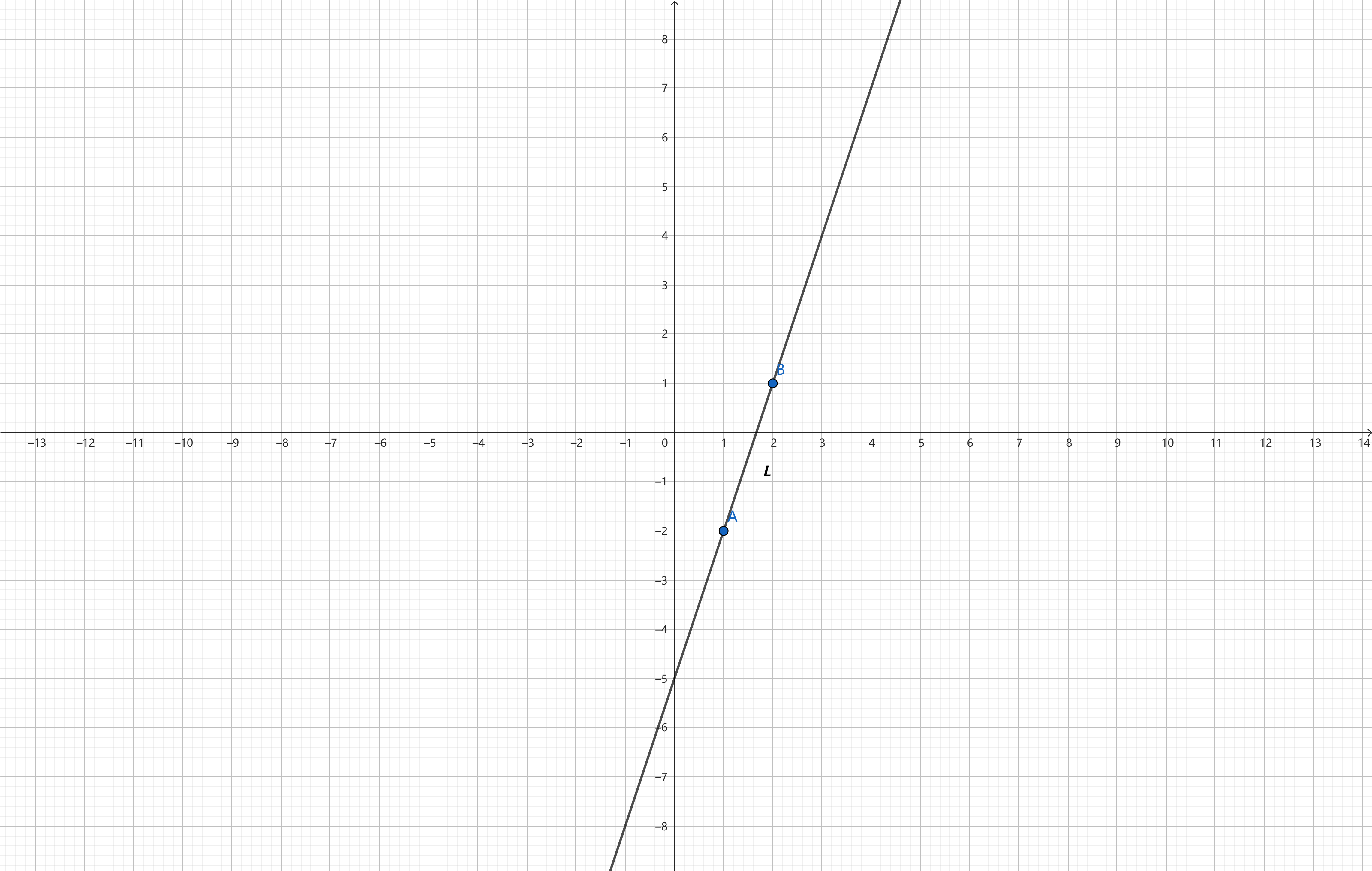
A(1, -2), B(2, 1)
 $$
m = \frac{\Delta{y}}{\Delta{x}} = \frac{B_y - A_y}{B_x - A_x} = \frac{1 - (-2)}{2 - 1} = \frac{3}{1} = 3
$$
$$
m = \frac{\Delta{y}}{\Delta{x}} = \frac{B_y - A_y}{B_x - A_x} = \frac{1 - (-2)}{2 - 1} = \frac{3}{1} = 3
$$ -
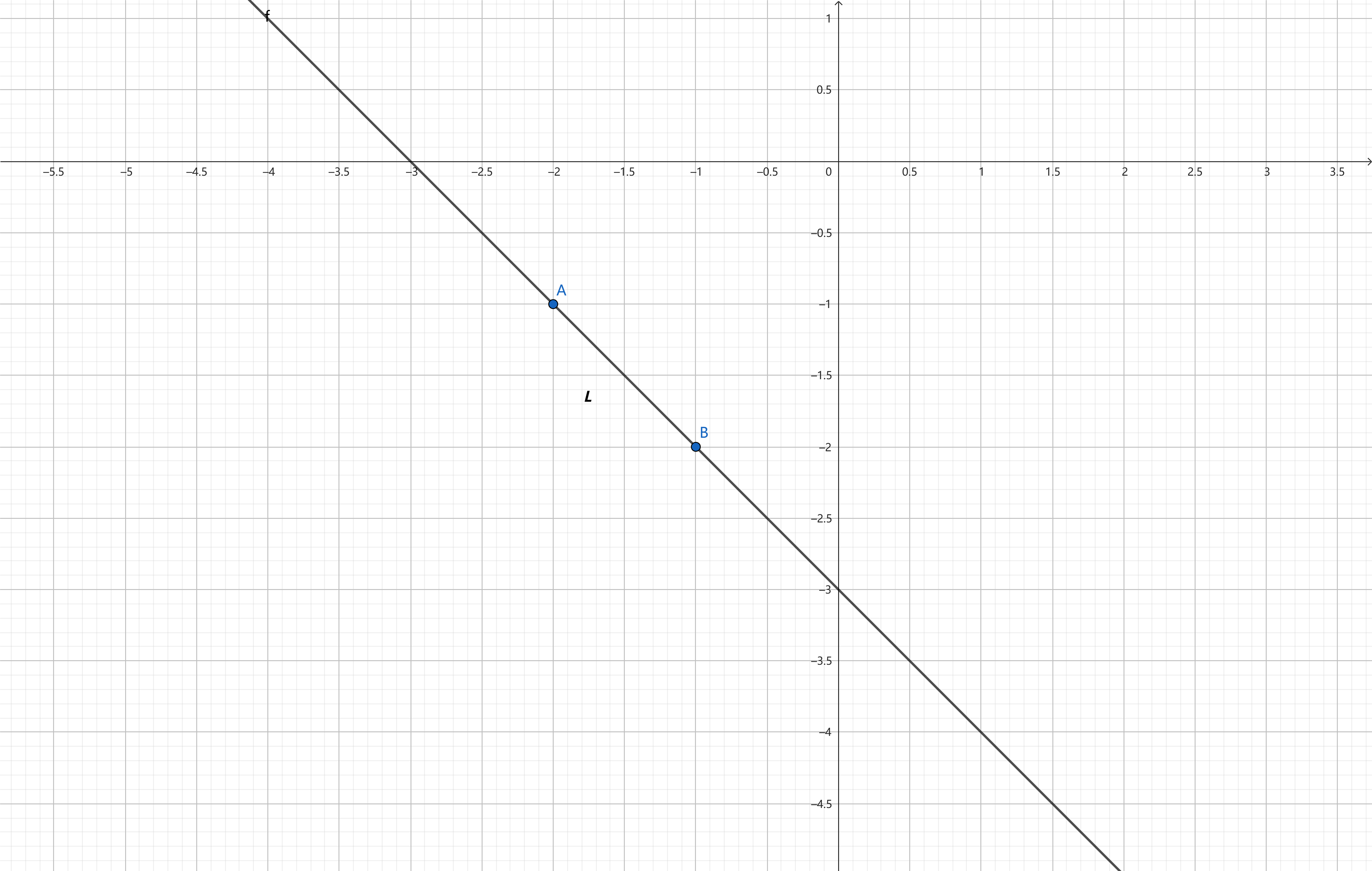
A (-2, -1), B(-1, -2)
$$
m = \frac{\Delta{y}}{\Delta{x}} = \frac{B_y - A_y}{B_x - A_x} = \frac{-2 - (-1)}{-1 - (-2)} = \frac{-1}{1} = -1
$$
-
-
-
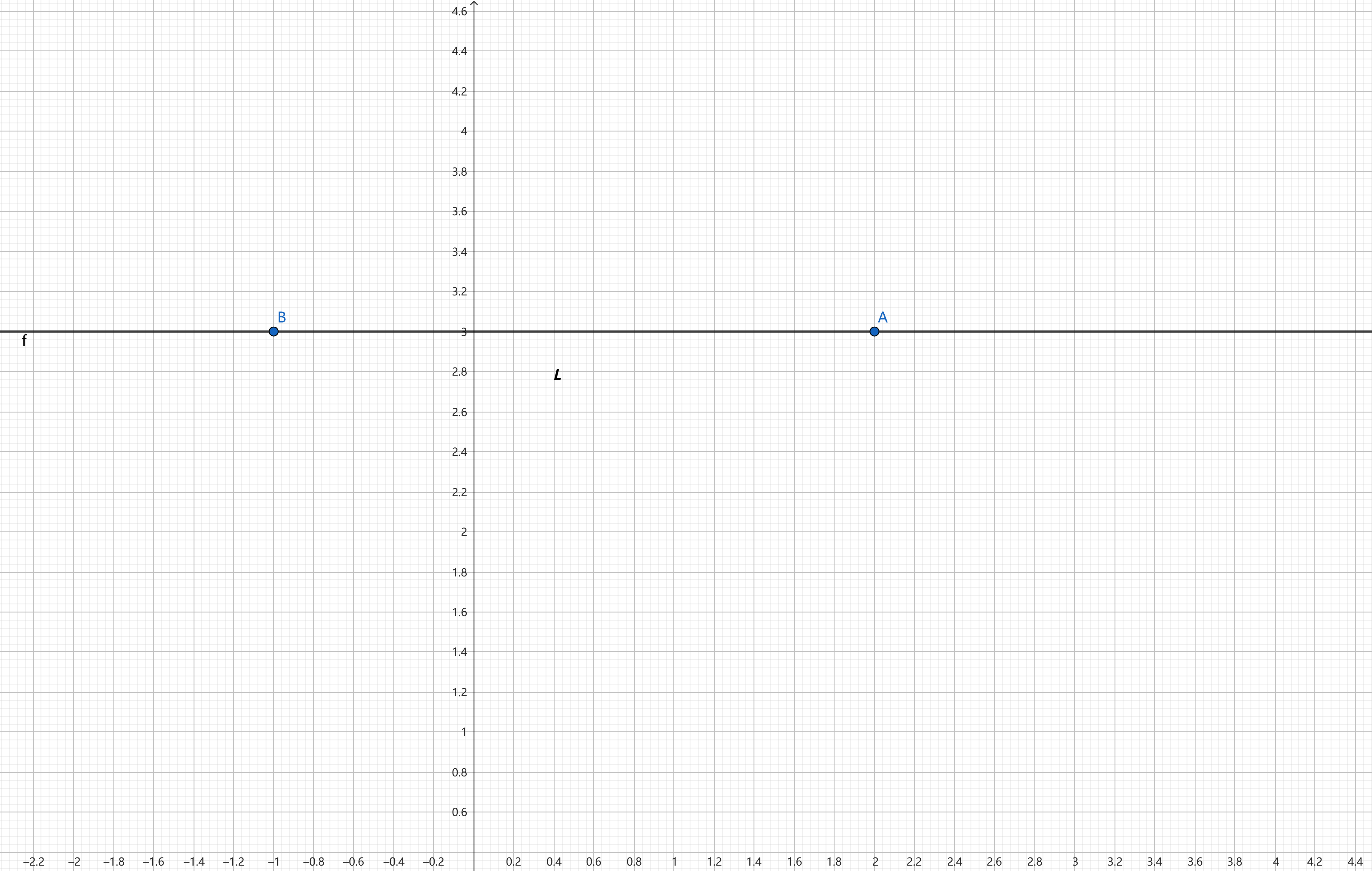
A(2, 3), B(-1, 3)
光看y轴就是一条水平线,故斜率为0
-
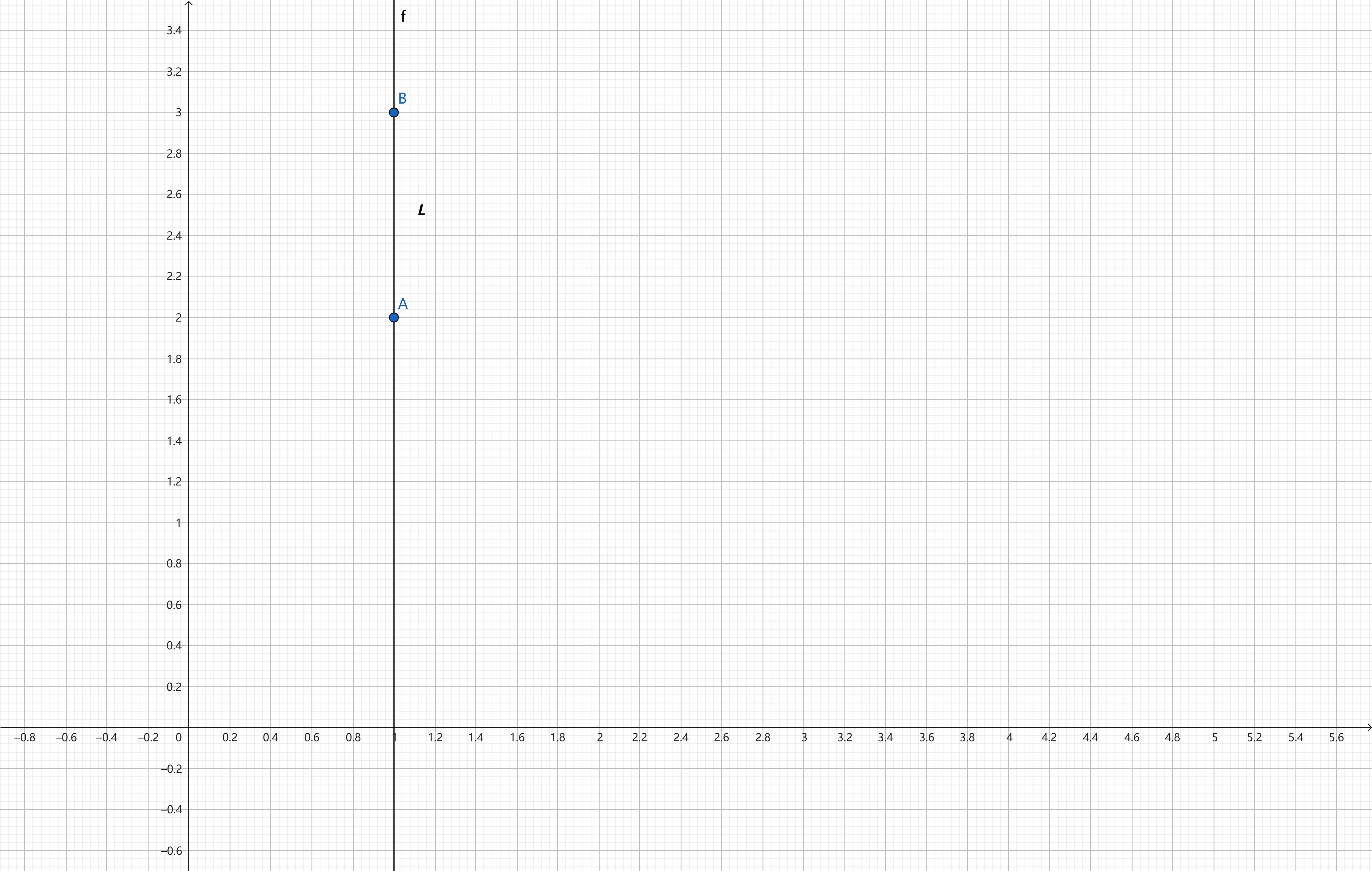
A(1, 2), B(1, -3)
x轴相等,所以这是一条垂直线,斜率无意义
-
 $$
m = \frac{\Delta{y}}{\Delta{x}} = \frac{B_y - A_y}{B_x - A_x} = \frac{1 - (-2)}{2 - 1} = \frac{3}{1} = 3
$$
$$
m = \frac{\Delta{y}}{\Delta{x}} = \frac{B_y - A_y}{B_x - A_x} = \frac{1 - (-2)}{2 - 1} = \frac{3}{1} = 3
$$ $$
m = \frac{\Delta{y}}{\Delta{x}} = \frac{B_y - A_y}{B_x - A_x} = \frac{-2 - (-1)}{-1 - (-2)} = \frac{-1}{1} = -1
$$
$$
m = \frac{\Delta{y}}{\Delta{x}} = \frac{B_y - A_y}{B_x - A_x} = \frac{-2 - (-1)}{-1 - (-2)} = \frac{-1}{1} = -1
$$
在题 5 和 题 6 中,对过点 P 的 垂直线 以及 水平线写出方程
在题 7 和 题 8中,对过点P的斜率为 m 的直线写出 点斜式方程
-
-
P(1, 1), m = 1 $$ \begin{gather*} y = m(x - x_1) + y_1 \\ y = 1(x - 1) + 1 \\ y = x \end{gather*} $$
-
P(-1, 1),m = -1 $$ \begin{gather*} y = m(x - x_1) + y_1 \\ y = -1(x - (-1)) + 1 \\ y = -x \end{gather*} $$
-
-
-
P(0, 3),m = 2 $$ \begin{gather*} y = m(x - x_1) + y_1 \\ y = 2(x - 0) + 3 \\ y = 2x + 3 \end{gather*} $$
-
P(-4, 0),m = -2 $$ \begin{gather*} y = m(x - x_1) - y_1 \\ y = -2(x - (-4)) - 0 \\ y = -2x - 8 \end{gather*} $$
-
在题 9 和 题 10 中,写出过两点的一般线性方程
-
-
(0,0),(2,3) $$ \begin{gather*} m = \frac{3 - 0}{2 - 0} = \frac{3}{2} \\ \\ y = m(x - x_1) + y_1 \quad (用(0,0)) \\ \\ y = \frac{3}{2}(x - 0) + 0 \\ \\ y = \frac{3}{2}x \\ \\ 2y = 3x \\ \\ 3x - 2y = 0 \end{gather*} $$
-
(1,1),(2,1) $$ \begin{gather*} m = \frac{1 - 1}{2 - 1} = 0 \\ \\ y = m(x - x_1) + y_1 \quad (用(1,1)) \\ \\ y = 0(x - 1) + 1 \\ \\ y = 1 \\ \\ y - 1 = 0 \\ \\ 0x + y - 1 = 0 \end{gather*} $$
-
-
-
(-2,0),(-2,-2)
通过计算斜率 $ m &= \frac{-2 - 0}{-2 - (-2)} = \frac{-2}{0} $ 发现分母为 0 ,斜率无意义,所以这是一条垂直线
对于垂直线,线上所有点的 x 坐标都相同。观察两个点,它们的 x 坐标都是 -2。所以方程就是 x = -2
-
(-2,1),(2,-2) $$ \begin{gather*} m = \frac{-2 - 1}{2 - (-2)} = \frac{-3}{4} \\ \\ y = m(x - x_1) + y_1 \quad (用(-2,1)) \\ \\ y = -\frac{3}{4}(x - (-2)) + 1 \\ \\ 4y = -3(x + 2) + 4 \\ \\ 4y = -3x - 6 + 4 \\ \\ 3x + 4y = -2 \end{gather*} $$
-
在题 11 和 题 12 中,对斜率为 m,y - 截距 为 b 的直线 写出 斜率截距方程
-
-
m = 3,b = -2 $$ \begin{gather*} y = mx + b \\ y = 3x - 2 \end{gather*} $$
-
m = -1,b = 2 $$ \begin{gather*} y = mx + b \\ \\ y = -x + 2 \end{gather*} $$
-
-
-
$ m = \frac{-1}{2},b = -3 $ $$ \begin{gather*} y = mx + b \\ \ y = -\frac{1}{2}x - 3 \end{gather*} $$
-
$ m = \frac{1}{3},b = -1 $ $$ \begin{gather*} y = mx + b \\ \\ y = \frac{1}{3}x - 1 \end{gather*} $$
-
求函数的公式 - 习题
-
把等边三角形的面积和周长表为该三角形边长 x 的函数 $$ \begin{gather*} \text{周长:} \quad y = f(x) = x + x + x = 3x \\ \\ \text{面积:} \quad y = f(x) = \frac{1}{2}ab \sin(C) = \frac{1}{2} \cdot x \cdot x \cdot \sin{60} = \frac{\sqrt{3}}{4}x^2 \end{gather*} $$
-
把正方形的边长表为该正方形对角线长度 d 的函数,然后把该正方形的面积表为对角线长度的函数 $$ \begin{gather*} \text{边长:} \quad y = f(x) \Rightarrow y^2 \cdot y^2 = d^2 \Rightarrow y = \frac{d}{\sqrt{2}} \\ \\ \text{面积:} \quad y = f(x) = \frac{d}{\sqrt{2}} * \frac{d}{\sqrt{2}} = \frac{d^2}{2} \end{gather*} $$
-
把立方体的棱边长表为该立方体对角线长度 d 的函数,然后把该立方体的表面积和体积表为对角线长度的函数 $$ \begin{gather*} \text{边长:} y = f(x) = (\frac{\sqrt{3}}{3})d \\ \\ \text{表面积:} y = f(x) = 2d^2 \\ \\ \text{体积:} y = f(x) = (\frac{\sqrt{3}}{9})d^2 \end{gather*} $$
-
第一象限中的点 P 位于函数 $ f(x) = \sqrt{x} $ 的图形上,把点 P 的坐标表为连接点 P 和原点的直线的斜率的函数 $$ P(m) = (\frac{1}{m^2}, \frac{1}{m}) \quad m > 0 $$
在题五 题六中,哪些图是 x 的函数,哪些不是,给出回答和理由
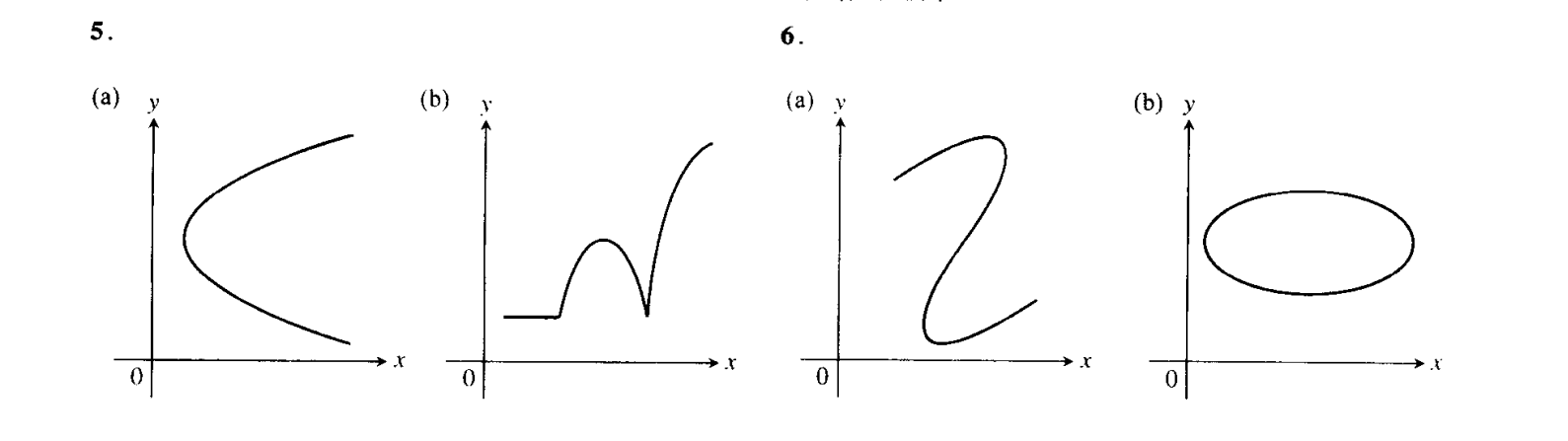
只有题五-b 是x 的函数,因为 一个 x 只能 对应一个 y
定义域和值域 - 习题
在 题7 - 题10 中,求每个函数的定义域和值域
-
-
$ f(x) = 1 + x^2 $ $$ \begin{gather*} 定义域:(-\infty,\infty) \\ \\ 值域:[1, \infty) \end{gather*} $$
-
$ f(x) = 1 - \sqrt{x} $ $$ \begin{gather*} 定义域:[0, \infty) \\ \\ 值域: (-\infty, 1] \end{gather*} $$
-
-
-
$ F(t) = \frac{1}{\sqrt{t}} $ $$ \begin{gather*} 定义域: [0, \infty) \\ \\ 值域:(0, \infty) \end{gather*} $$
-
$ F(t) = \frac{1}{1 + \sqrt{t}} $ $$ \begin{gather*} 定义域: [0, \infty) \\ \\ 值域:(0, 1] \end{gather*} $$
-
-
- $ g(z) = \sqrt{4 - z^2} $ $$ \begin{gather*} 定义域: [-2, 2] \\ \\ 值域:[0,2] \end{gather*} $$
-
- $ g(z)=\sqrt[3]{z-3} $ $$ \begin{gather*} 定义域: (-\infty,\infty) \\ \\ 值域:(-\infty,\infty) \end{gather*} $$
函数和图形 - 习题
画 题十一 和 题十二的图形,如果图形有对称性的话,是什么样的对称性?
-
-
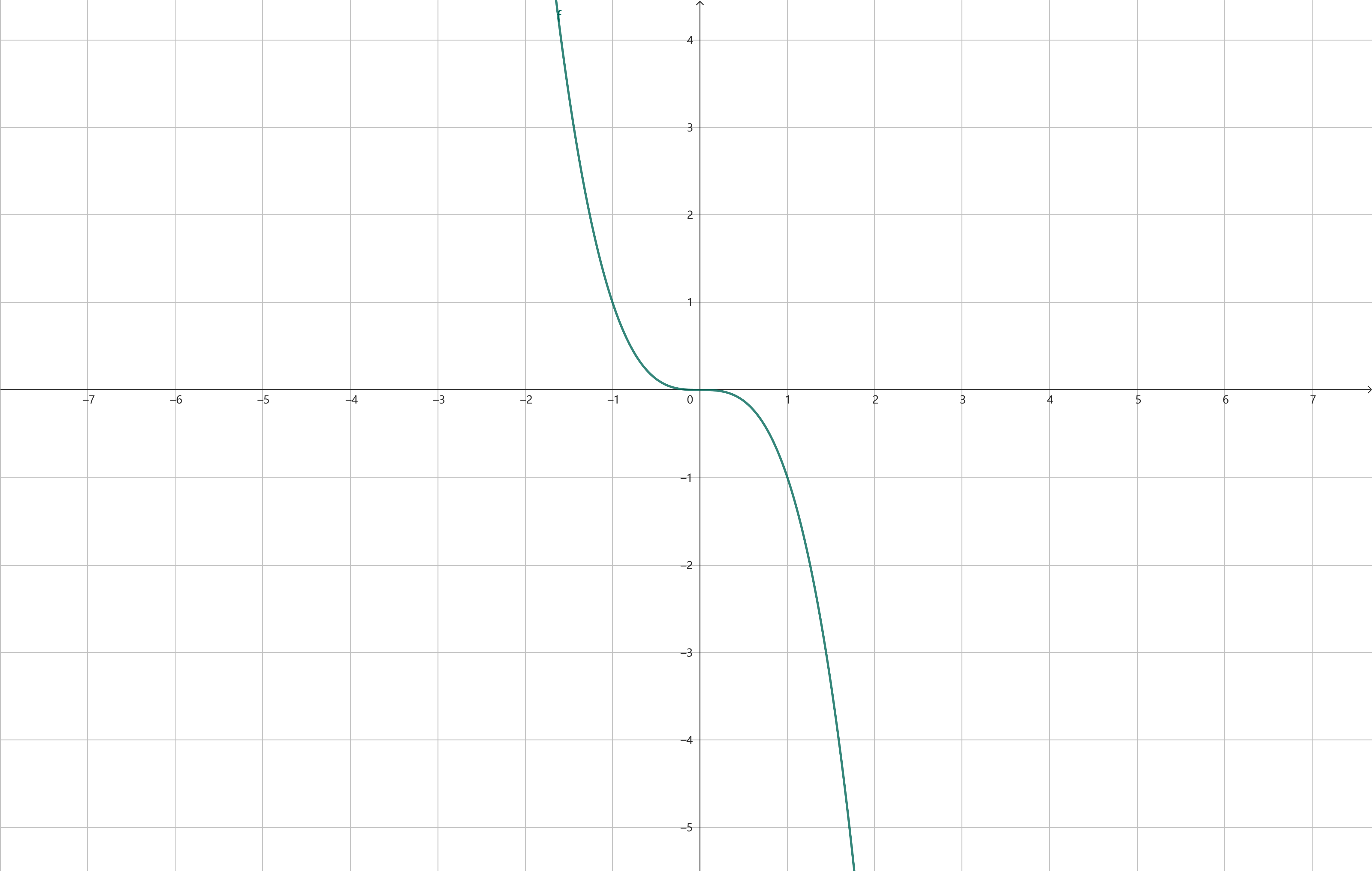
$ y = -x^3 $
原点对称,是个奇函数
-
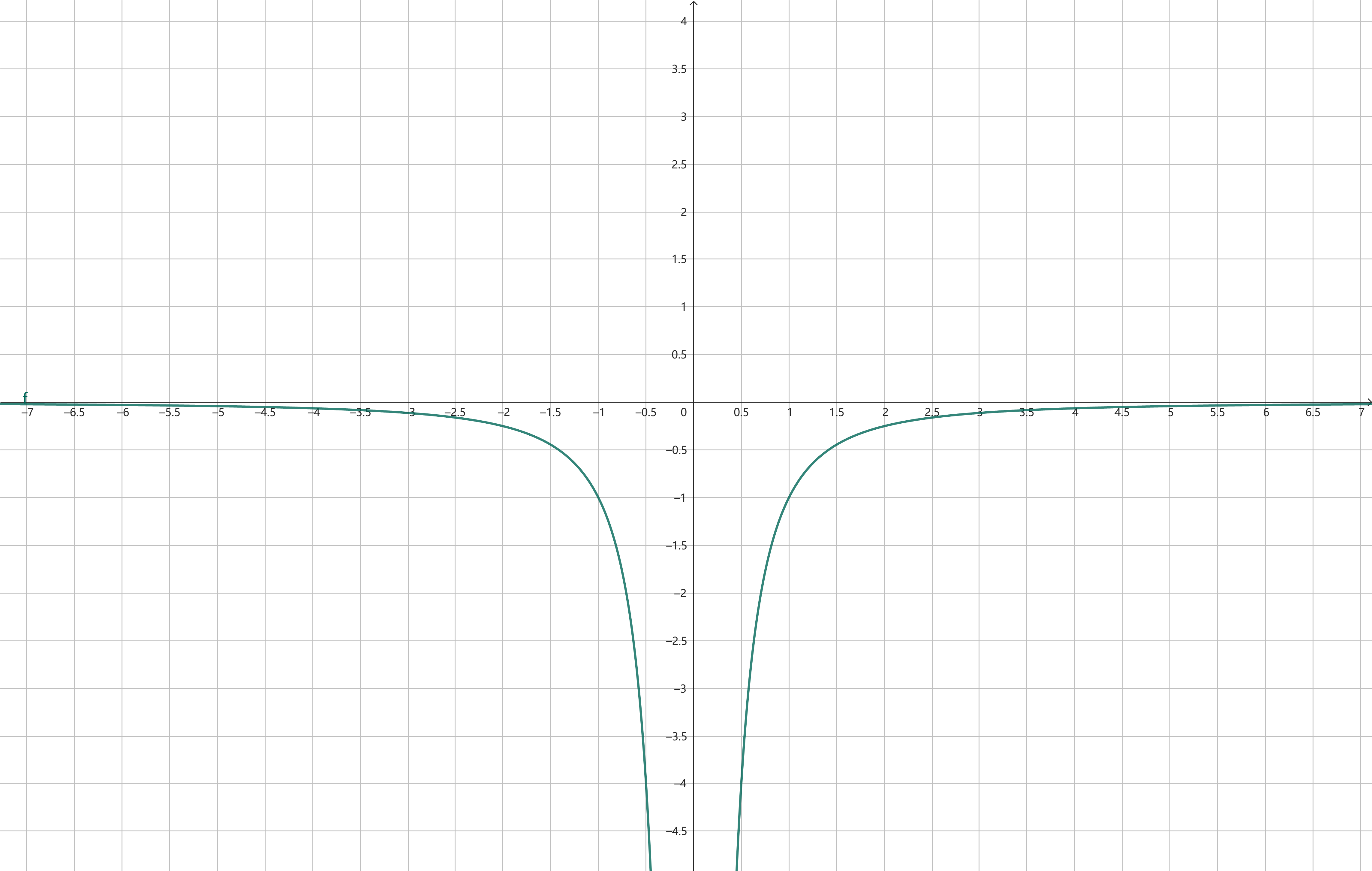
$ y = -\frac{1}{x^2} $
很明显 y轴对称,是个偶函数
-
-
-
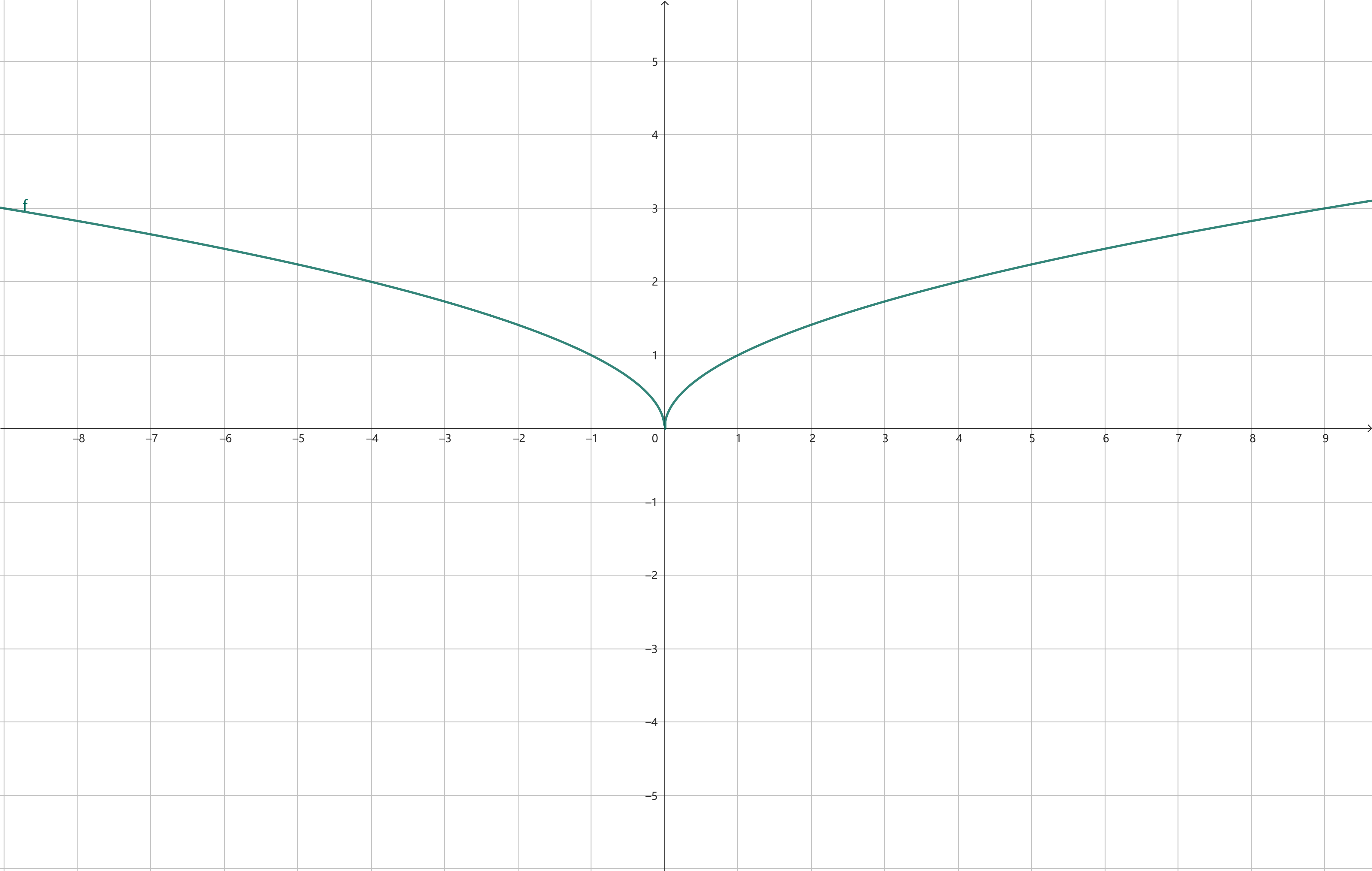
$ y = \sqrt{\mid x\mid } $
y轴对称,偶函数
-
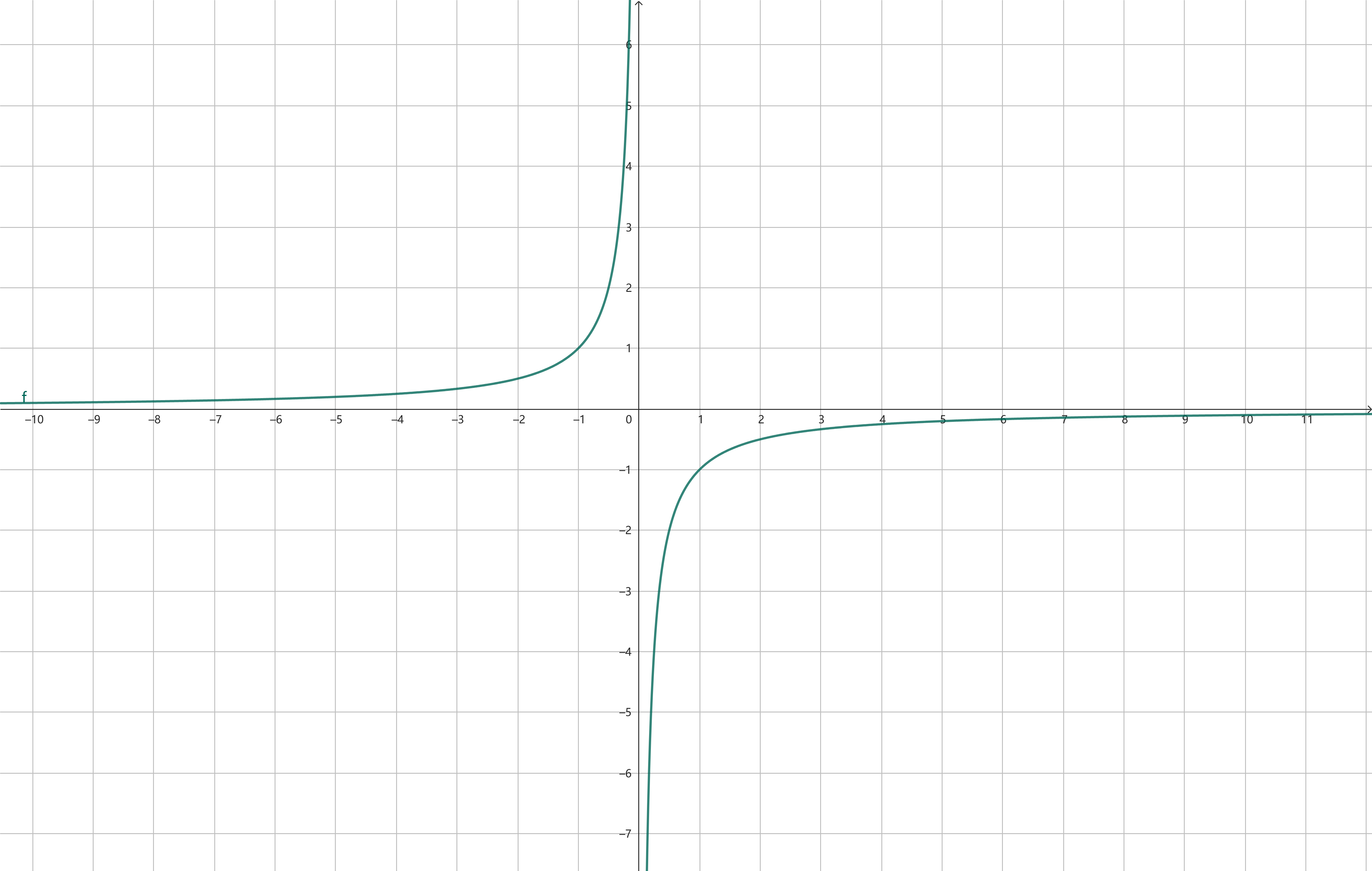
$ y = -\frac{1}{x} $
原点对称,是一个奇函数
-
-
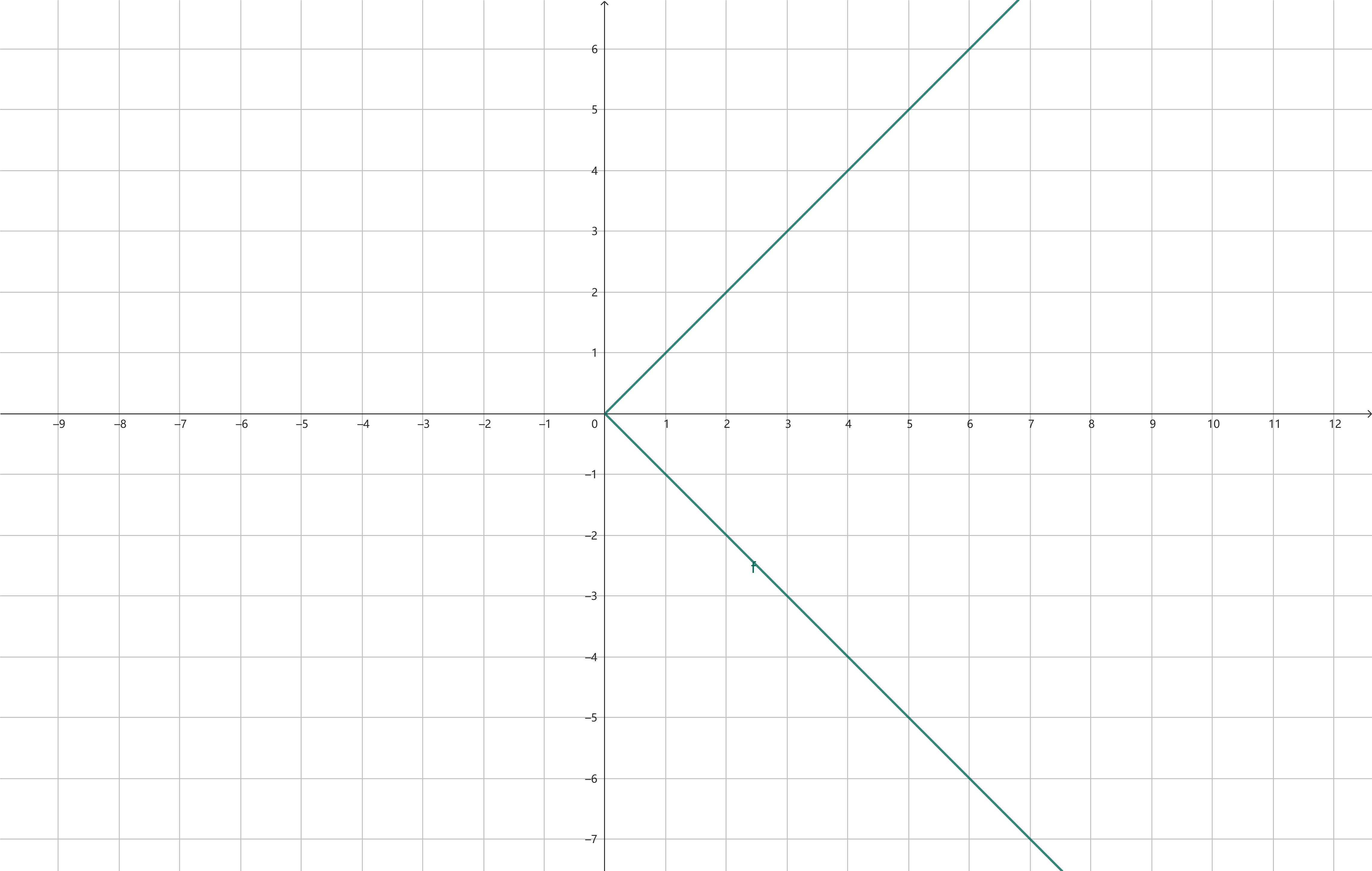
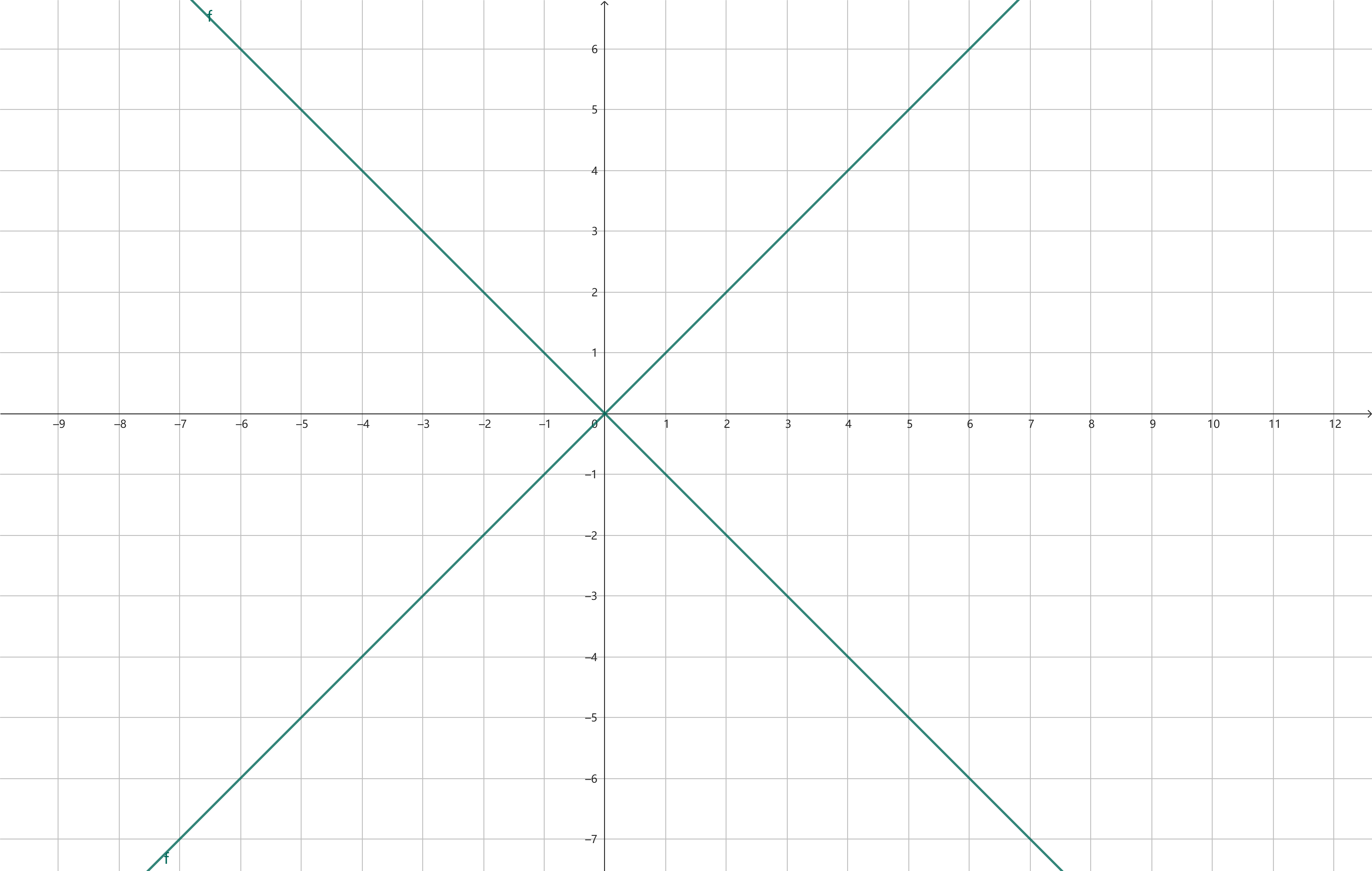
画出下列式子的图形并解释他们为什么不是 x 的函数
-
$ \mid y \mid = x $
因为一个 x 上有多个 y
-
$ y^2 = x^2 $
因为一个 x 上有多个 y
-
-
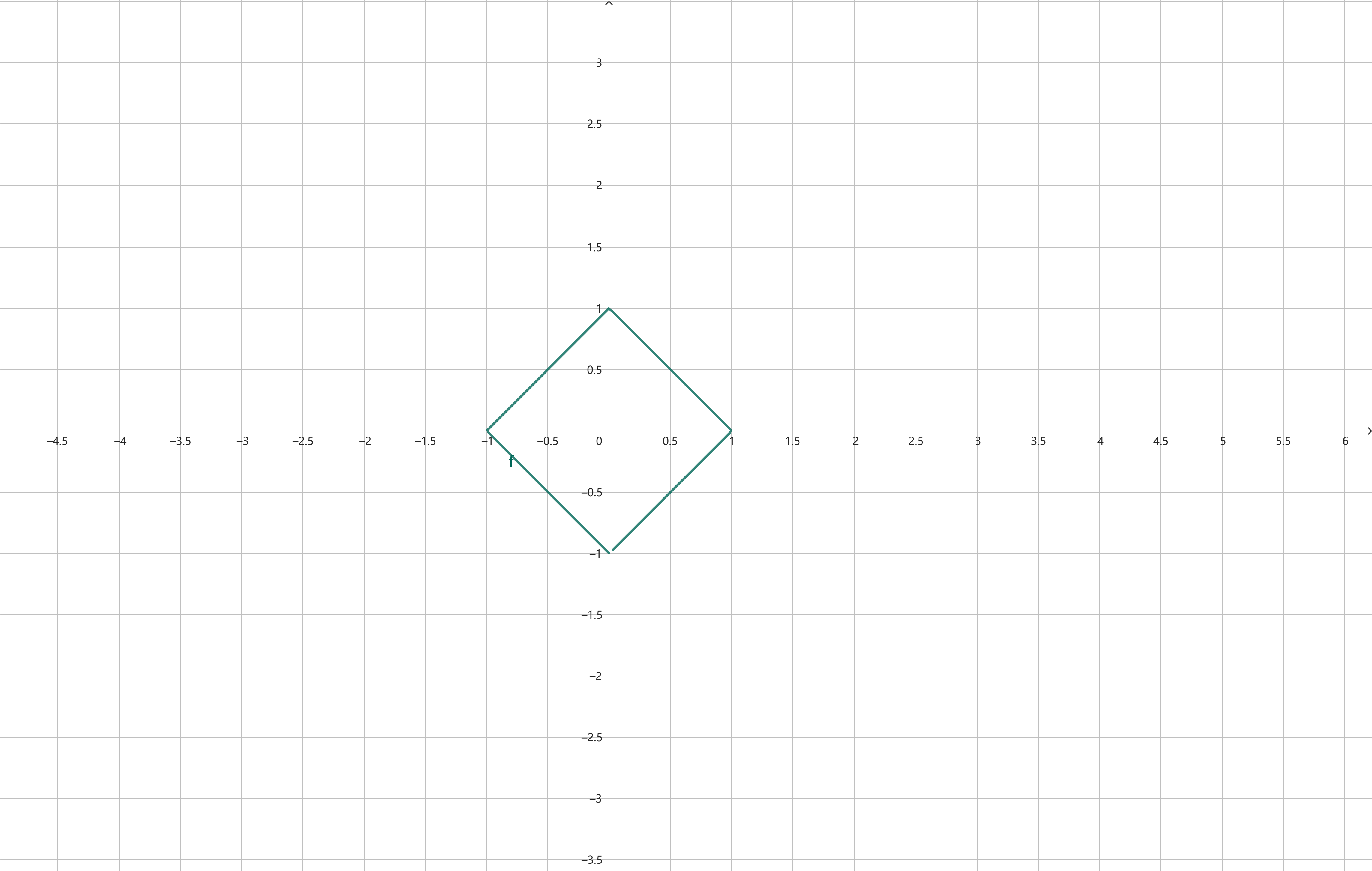
画出下列式子的图形并解释他们为什么不是 x 的函数
-
$ \mid x \mid + \mid y \mid = 1 $
因为一个 x 上有多个 y
-
$ \mid x + y \mid = 1 $
因为一个 x 上有多个 y
-
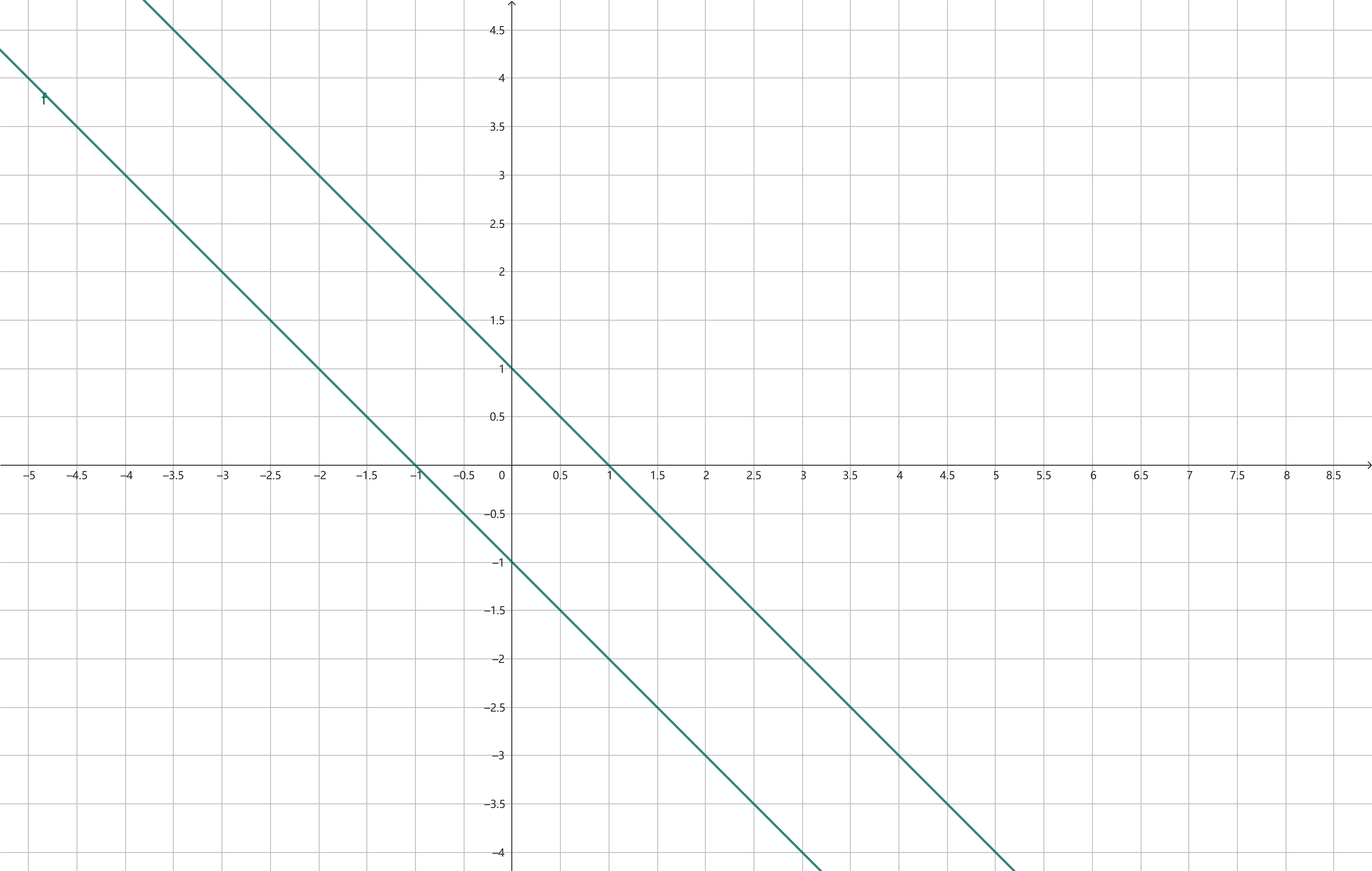
偶函数和奇函数 - 习题
在题 15 - 20 中,说出函数是否是偶函数、奇函数或两者都不是
-
-
$ f(x) = 3 $
偶函数,因为 y 永远都等于 3,也就是 $ f(x) = f(-x) $ $$ f(x) = 3 \quad f(-x) = 3 $$
-
$ f(x) = x^{-5} $
奇函数,因为 $ f(x) \neq f(-x) $,但是 $ f(-x) = -f(x) $ $$ \begin{gather*} f(-x) = -(x)^{-5} = \frac{1}{-x^5} = -\frac{1}{x^5} \\ \\ f(x) = x^{-5} = \frac{1}{x^5} \\ \\ -f(x) = -(x^{-5}) = -\frac{1}{x^5} \\ \\ f(-x) = -f(x) \end{gather*} $$
-
-
-
$ f(x) = x^2 + 1 $
偶函数 $$ \begin{gather*} f(x) = x^2 + 1 \\ \\ f(-x) = (-x)^2 + 1 = x^2 + 1 \\ \\ f(x) = f(-x) \end{gather*} $$
-
$ f(x) = x^2 + x $
两者都不是 $$ \begin{gather*} f(x) = x^2 + x \\ \\ f(-x) = (-x)^2 - x = x^2 - x \\ \\ -f(x) = -(x^2 + x) = -x^2 - x \end{gather*} $$
-
-
-
$ g(x) = x^3 + x $
奇函数 $$ \begin{gather*} g(x) = x^3 + x \\ \\ g(-x) = (-x)^3 - x = -x^3 - x \\ \\ -g(x) = -(x^3 + x) = -x^3 - x \end{gather*} $$
-
$ g(x) = x^4 + 3x^2 - 1 $
偶函数 $$ \begin{gather*} g(x) = x^4 + 3x^2 - 1 \\ \\ g(-x) = (-x)^4 + 3(-x)^2 - 1 = x^4 + 3x^2 - 1 \\ \\ g(x) = g(-x) \end{gather*} $$
-
-
-
$ g(x) = \frac{1}{x^2 - 1} $
偶函数 $$ \begin{gather*} g(x) = \frac{1}{x^2 - 1} \\ \\ g(-x) = \frac{1}{(-x)^2 - 1} = \frac{1}{x^2 - 1} \end{gather*} $$
-
$ g(x) = \frac{x}{x^2 - 1} $
奇函数 $$ \begin{gather*} g(x) = \frac{x}{x^2 - 1} \\ \\ g(-x) = \frac{-x}{(-x)^2 - 1} = -\frac{x}{x^2 - 1} \\ \\ -g(x) = -(\frac{x}{x^2 - 1}) = -\frac{x}{x^2 - 1} \\ \\ g(-x) = -g(x) \end{gather*} $$
-
-
-
$ h(t) = \frac{1}{t - 1} $
两者都不是 $$ \begin{gather*} h(t) = \frac{1}{t - 1} \\ \\ h(-t) = \frac{1}{-t - 1} = -\frac{1}{t+1} \\ \\ -h(t) = -\frac{1}{t -1} \end{gather*} $$
-
$ h(t) = \mid t^3 \mid $
偶函数 $$ \begin{gather*} h(t) = \mid t^3 \mid \\ \\ h(-t) = \mid (-t)^3 \mid \\ \\ h(t) = h(-t) \end{gather*} $$
-
-
-
$ h(t) = \sqrt{t^2 + 3} $
偶函数 $$ \begin{gather*} h(t) = \sqrt{t^2 + 3} \\ \\ h(-t) = \sqrt{(-t)^2 + 3} = \sqrt{t^2 + 3} \\ \\ h(t) = h(-t) \end{gather*} $$
-
$ h(t) = 2\mid t \mid + 1 $
偶函数 $$ \begin{gather*} h(t) = 2\mid t \mid + 1 \\ \\ h(-t) = 2 \mid -t \mid + 1 \\ \\ h(t) = h(-t) \end{gather*} $$
-
指数函数 - 习题
在题 1 - 6 中,把下列图形和下列函数配对
- $ y = 2^2 $
- $ y = 3^{-x} $
- $ y = -3^{-x} $
- $ y = -0.5^{-x} -2 $
- $ y = 2^{-x} - 2 $
- $ y = 1.5^x - 2 $
在题 7 - 10 中,画函数的图形,说出其定义域、值域和截距
-
$ y = -2^x + 3 $
-
定义域:$ (- \infty,+ \infty) $
-
值域:$ (- \infty, 3) $
-
$$ \begin{gather*} -2^x + 3 = 0 \quad -2^x = -3 \quad 2^x = 3 \quad x = log_2(3) \\ \\ y = -2^0 + 3 = -1 + 3 = 2 \end{gather*} $$
-
-
$ y = e^x + 3 $
-
定义域:$ (- \infty,+ \infty) $
-
值域:$ (3, + \infty) $
-
$$ \begin{gather*} 0 = e^x + 3 \quad e^x = -3 \quad \text{因为}e^x\text{的值恒为正,所以没有x截距,此方程无意义} \\ \\ y = e^0 + 3 = 1 + 3 = 4 \end{gather*} $$
-
-
$ y = 3 \cdot e^{-x} - 2 $
-
定义域:$ (- \infty,+ \infty) $*
-
值域:$ (-2, + \infty) $
-
$$ \begin{gather*} 0 = 3 \cdot e^{-x} -2 \quad \frac{1}{e^{x}} = \frac{2}{3} \quad e^x = \frac{3}{2} \quad x = \ln{ \frac{3}{2}} \\ \\ y = 3 \cdot e^0 - 2 = 3 \cdot 1 - 2 = 1 \end{gather*} $$
-
-
$y = -2^{-x} - 1$
-
定义域:$ (- \infty,+ \infty) $
-
值域:$ (- \infty,-3) $
-
$$ \begin{gather*} 0 = -2^{-x} - 1 \quad 1 = -2^{-x} \quad 2^{-x} = -1 \quad \text{因为}2^{-x}\text{值恒为证数,所以没有x截距,此方程无意义} \\ \\ y = -2^0 - 1 = -1 - 1 = -2 \end{gather*} $$
-
在题 11 - 14 中,重写具有指定底的指数函数
-
$ 9^{2x},底为 3 $ $$ 9^{2x} \Rightarrow 3^{2 \cdot {2x}} \Rightarrow 3^{4x} $$
-
$ 16^{3x},底为 2 $ $$ 16^{3x} = 2^{4 \cdot 3x} = 2^{12x} $$
-
$ (\frac{1}{8})^{2x},底为 2 $ $$ (\frac{1}{8})^{2x} = 2^{-3 \cdot 2x} = 2^{-6x} $$
-
$ (\frac{1}{27})^x,底为 3 $ $$ (\frac{1}{27})^x = 3^{-3 \cdot x} = 3^{-3x} $$
从图形识别一对一函数 - 习题
题 1 - 6 中图示的函数中那些是一对一的,哪些不是一对一的
1,5,6是一对一函数,其余不是一对一函数
画反函数的图形 - 习题
题 7 - 10 中每道题都展示了函数 $ y = f(x) $ 的图形,复制该图形并画上直线 $ y = x$,然后利用对直线 $ y =x$ 的对成型把 $ f^{-1} $ 的图形加到你的图上(不必求 $ f^{-1} $ 的方程),识别 $ f^{-1} $ 的定义域和值域
反函数的方程 - 习题
题 11 - 16 给出了函数 $ y = f(x) $ 的方程并展示了 $f$ 和 $f^{-1}$ 的图形,求每题中 $f^{-1}$ 的方程
-
$ f(x) = x^2 + 1,x \geq 0 $ $$ \begin{gather*} y = x^2 + 1,x \geq 0 \\ \\ x = y^2 + 1 \quad \text{x,y交换} \\ \\ x - 1 = y^2 \\ \\ y = \pm \sqrt{x - 1} \\ \\ \text{原函数的定义域是} x \geq 0 \text{,所以这意味反函数的值域必须是} y \geq 0 \\ \\ y = \sqrt{x - 1} \quad \Rightarrow \quad f^{-1}(x) = \sqrt{x - 1} \end{gather*} $$
-
$ f(x) = x^2,x \leq 0 $ $$ \begin{gather*} y = x^2, x \leq 0 \\ \\ x = y^2 \quad \text{x,y交换} \\ \\ y = \pm \sqrt{x} \\ \\ \text{原函数的定义域是} x \leq 0 \text{,所以这意味反函数的值域必须是} y \leq 0 \\ \\ y = -\sqrt{x} \quad \Rightarrow \quad f^{-1}(x) = -\sqrt{x} \end{gather*} $$
-
$ f(x) = x^3 - 1 $ $$ \begin{gather*} f(x) = x^3 - 1 \\ \\ y = x^3 - 1 \\ \\ x = y^3 - 1 \quad \text{x,y交换} \\ \\ y = \sqrt[3]{x - 1} \\ \\ f^{-1}(x) = \sqrt[3]{x - 1} \end{gather*} $$
-
$ f(x) = x^2 - 2x + 1,x \geq 1 $ $$ \begin{gather*} f(x) = x^2 - 2x + 1,x \geq 1 \\ \\ y = x^2 - 2x + 1 \\ \\ y = (x - 1)^2 \\ \\ x = (y - 1)^2 \quad \text{x,y交换} \\ \\ y - 1 = \pm \sqrt{x} \\ \\ y = \pm \sqrt{x} + 1 \\ \\ \text{原函数的定义域是} x \geq 1 \text{,所以这意味反函数的值域必须是} y \geq 1 \\ \\ y = \sqrt{x} + 1 \quad \Rightarrow \quad f^{-1}(x) = \sqrt{x} + 1 \end{gather*} $$
-
$ f(x) = (x + 1)^2,x \geq 1 $ $$ \begin{gather*} f(x) = (x + 1)^2,x \geq 1 \\ \\ y = (x + 1)^2 \\ \\ x = (y + 1)^2 \quad \text{x,y交换} \\ \\ y + 1 = \pm \sqrt{x} \\ \\ \text{原函数的定义域是} x \geq 1 \text{,所以这意味反函数的值域必须是} y \geq 1 \\ \\ y = \sqrt{x} - 1 \quad \Rightarrow \quad f^{-1}(x) = \sqrt{x} - 1 \end{gather*} $$
-
$ f(x) = x^{2/3},x \geq 0 $ $$ \begin{gather*} f(x) = x^{2/3},x \geq 0 \\ \\ y = x^{2/3} \\ \\ x = y^{2/3} \quad \text{x,y交换} \\ \\ x^{3/2} = (y^{2/3})^{3/2} \\ \\ y = x^{3/2} \\ \\ y = \sqrt{x}^3 \\ \\ \text{原函数的定义域是} x \geq 0 \text{,所以这意味反函数的值域必须是} y \geq 0 \\ \\ y = \sqrt{x}^3 \quad \Rightarrow \quad f^{-1}(x) = \sqrt{x}^3 \end{gather*} $$
求反函数 - 习题
在题 17 - 28 中,求 $ f^{-1} $ 并验证 $ (f\circ f^{-1})(x)=(f^{-1}\circ f)(x)=x $
-
$ f(x) = 2x + 3 $
求 $ f^{-1} $ $$ \begin{gather*} f(x) = 2x + 3 \\ \\ y = 2x + 3 \\ \\ y - 3 = 2x \\ \\ \frac{y-3}{2} = x \\ \\ y = \frac{x - 3}{2} \quad \text{交换x,y} \\ \\ f^{-1}(x) = \frac{x - 3}{2} \end{gather*} $$ 验证 $ f(f^{-1}(x)) = f^{-1}(f(x)) $ $$ \begin{gather*} f(f^{-1}(x)) = f(\frac{x - 3}{2}) = 2(\frac{x - 3}{2}) + 3 = x - 3 + 3 = x \\ \\ f^{-1}(f(x)) = f^{-1}(2x + 3) = \frac{2x + 3 -3}{2} = \frac{2x}{2} = x \\ \\ f(f^{-1}(x)) = f^{-1}(f(x)) \end{gather*} $$
-
$ f(x) = 5 - 4x $
求 $ f^{-1} $ $$ \begin{gather*} f(x) = 5 - 4x \\ \\ y = 5 - 4x \\ \\ 4x = -(y - 5) \\ \\ x = -\frac{y - 5}{4} \\ \\ y = -\frac{x - 5}{4} \quad \text{交换x,y} \\ \\ \quad f^{-1}(x) = -\frac{x - 5}{4} = \frac{5 - x}{4} \end{gather*} $$ 验证 $ f(f^{-1}(x)) = f^{-1}(f(x)) $ $$ \begin{gather*} f(f^{-1}(x)) = f(\frac{5 - x}{4}) = 5 - 4(\frac{5 - x}{4})= 5 - (5 - x) = x \\ \\ f^{-1}(f(x)) = f^{-1}(5 - 4x) = \frac{5 - (5 - 4x)}{4} = \frac{4x}{4} = x \\ \\ f(f^{-1}(x)) = f^{-1}(f(x)) \end{gather*} $$
-
$ f(x) = x^3 - 1 $
求 $ f^{-1} $ $$ \begin{gather*} f(x) = x^3 - 1 \\ \\ y = x^3 - 1 \\ \\ y + 1 = x^3 \\ \\ \sqrt[3]{y + 1} = x \\ \\ y = \sqrt[3]{x + 1} \quad \text{x,y交换} \\ \\ f^{-1}(x) = \sqrt[3]{x + 1} \end{gather*} $$ 验证 $ f(f^{-1}(x)) = f^{-1}(f(x)) $ $$ \begin{gather*} f(f^{-1}(x)) = f(\sqrt[3]{x + 1}) = \sqrt[3]{x + 1}^3 - 1 = x + 1 - 1 = x \\ \\ f^{-1}(f(x)) = f^{-1}(x^3 - 1) = \sqrt[3]{x^3 + 1 - 1} = x \\ \\ f(f^{-1}(x)) = f^{-1}(f(x)) \end{gather*} $$
-
$ f(x) = x^2 + 1,x \geq 0 $
求 $ f^{-1} $ $$ \begin{gather*} f(x) = x^2 + 1,x \geq 0 \\ \\ y = x^2 + 1 \\ \\ y - 1 = x^2 \\ \\ \sqrt{y - 1} = \sqrt{x^2} = \mid x \mid = x \quad \text{因为} x \geq 0 \text{所以} \mid x \mid = x \\ \\ y = \sqrt{x - 1} \\ \\ f^{-1}(x) = \sqrt{x - 1} \end{gather*} $$ 验证 $ f(f^{-1}(x)) = f^{-1}(f(x)) $ $$ \begin{gather*} f(f^{-1}(x)) = f(\sqrt{x-1}) = \sqrt{x-1}^2 + 1 = x - 1 + 1 = x \\ \\ f^{-1}(f(x)) = f^{-1}(x^2 + 1) = \sqrt{x^2 + 1 - 1} = x \\ \\ f(f^{-1}(x)) = f^{-1}(f(x)) \end{gather*} $$
-
$ f(x) = x^2,x \leq 0 $
求 $ f^{-1} $ $$ \begin{gather*} f(x) = x^2,x \leq 0 \\ \\ y = x^2 \\ \\ \sqrt{y} = \sqrt{x^2} = \mid x \mid = -x \quad \text{因为} x \leq 0 \text{所以} \mid x \mid = -x \\ \\ y = -\sqrt{x} \\ \\ f^{-1}(x) = -\sqrt{x} \end{gather*} $$
验证 $ f(f^{-1}(x)) = f^{-1}(f(x)) $ $$ \begin{gather*} f(f^{-1}(x)) = f(-\sqrt{x}) =(-\sqrt{x})^2 = x \\ \\ f^{-1}(f(x)) = f^{-1}(x^2) = -\sqrt{x^2} = -(-x) = x \quad \text{因为原函数定义域是} x \leq 0,\text{所以} -() \\ \\ f(f^{-1}(x)) = f^{-1}(f(x)) \end{gather*} $$
-
$ f(x) = x^{2/3},x \geq 0 $
求 $ f^{-1} $ $$ \begin{gather*} f(x) = x^{2/3},x \geq 0 \\ \\ y = x^{2/3} \\ \\ y^{3/2} = (x^{2/3})^{3/2} \\ \\ y^{3/2} = x \\ \\ y = x^{3/2} \quad \text{x,y 交换} \\ \\ f^{-1}(x) = x^{3/2} \end{gather*} $$ 验证 $ f(f^{-1}(x)) = f^{-1}(f(x)) $ $$ \begin{gather*} f(f^{-1}(x)) = f(x^{3/2}) = (x^{3/2})^{2/3} = x \\ \\ f^{-1}(f(x)) = f^{-1}(x^{2/3}) = (x^{2/3})^{3/2} = x \\ \\ f(f^{-1}(x)) = f^{-1}(f(x)) \end{gather*} $$
-
$ f(x) = -(x - 2)^2,x \leq 2 $
求 $ f^{-1} $ $$ \begin{gather*} f(x) = -(x - 2)^2,x \leq 2 \\ \\ y = -(x - 2)^2 \\ \\ \sqrt{-y} = \sqrt{(x - 2)^2} = \mid \sqrt{(x - 2)^2} \mid = -\sqrt{(x - 2)^2} \quad \text{因为} x \leq 2, 所以\mid \sqrt{(x - 2)^2} \mid = -\sqrt{(x - 2)^2} \\ \\ \sqrt{-y} - 2 = -x \\ \\ y = 2 - \sqrt{-x} \end{gather*} $$ 验证 $ f(f^{-1}(x)) = f^{-1}(f(x)) $ $$ \begin{gather*} f(f^{-1}(x)) = f(2 - \sqrt{-x}) = -(2 - \sqrt{-x} - 2)^2 = -(-\sqrt{-x})^2 = -(-x) = x \\ \\ f^{-1}(f(x)) = f^{-1}(-(x-2)^2) = 2 - \sqrt{-(-(x-2)^2)} = 2 - \sqrt{(x - 2)^2} = 2 - \mid (x - 2) \mid = 2 - (-x + 2) = 2 + x - 2 = x \\ \\ \text{因为} x \leq 2 所以 \mid (x - 2) \mid = -(x - 2) = -x + 2 \\ \\ f(f^{-1}(x)) = f^{-1}(f(x)) \end{gather*} $$
-
$ f(x) = x^2 + 2x + 1,x \geq -1 $
求 $ f^{-1} $ $$ \begin{gather*} f(x) = x^2 + 2x + 1,x \geq -1 \\ \\ y = x^2 + 2x + 1 \\ \\ y = (x + 1)^2 \\ \\ \sqrt{y} = \sqrt{(x + 1)^2} = \mid (x + 1) \mid = x + 1 \quad 因为 x \geq 1 所以 \mid (x + 1) \mid = x + 1 \\ \\ y = \sqrt{x} - 1 \quad x,y交换 \\ \\ f^{-1}(x) = \sqrt{x} - 1 \end{gather*} $$ 验证 $ f(f^{-1}(x)) = f^{-1}(f(x)) $ $$ \begin{gather*} f(f^{-1}(x)) = f(\sqrt{x} -1) = (\sqrt{x} -1 + 1)^2 = \mid x \mid = x; \\ \\ f^{-1}(f(x)) = f^{-1}((x+1)^2) = \sqrt{(x+1)^2} - 1 = \mid x + 1\mid -1 = x + 1 -1 = x \\ \\ \text{因为} x \leq 2 所以 \mid (x - 2) \mid = -(x - 2) = -x + 2 \\ \\ f(f^{-1}(x)) = f^{-1}(f(x)) \end{gather*} $$
-
$ f(x) = \frac{1}{x^2},x \le 0 $
-
$ f(x) = \frac{1}{x^3} $
-
$ f(x) = \frac{2x + 1}{x + 3} $
-
$ f(x) = \frac{x + 3}{x - 2} $
自然化指数和对数函数 - 习题
在题 29 - 30 中,把指数函数表为 e 的幂函数。求定义域和值域
- $y = 3^x - 1$
- $y = 4^{x+1)
在题 31 - 32 中,把函数用自然对数表示出来,求定义域和值域并画图
- $ y = 1 - (\ln3)\log_3 x $
- $ y = (\ln10)\log(x+2) $
解指数方程 - 习题
在题 33 - 36中,代数地求解方程,如果你有一图形计算器或计算机绘图器,试图解地证实你得到的解
- $(1.045)^t = 2$
- $ e^{0.05t} = 3 $
- $ e^x + e^{-x} = 3 $
- $ 2^x + 2^{-x} = 5 $
解包含对数项的方程 - 习题
在题 37 - 38 中,解 y
- $ \ln{y} = 2t + 4 $
- $ \ln{(y-1)} - \ln{2} = x + \ln{x} $